Flesh of My Flesh: Three Films by David Cronenberg
“For me the first fact of human existence is the human body. But if you embrace the reality of the human body, you are embracing your own mortality, and that is a very difficult thing for anybody to do. Because the self-conscious mind cannot imagine non-existence." — David Cronenberg

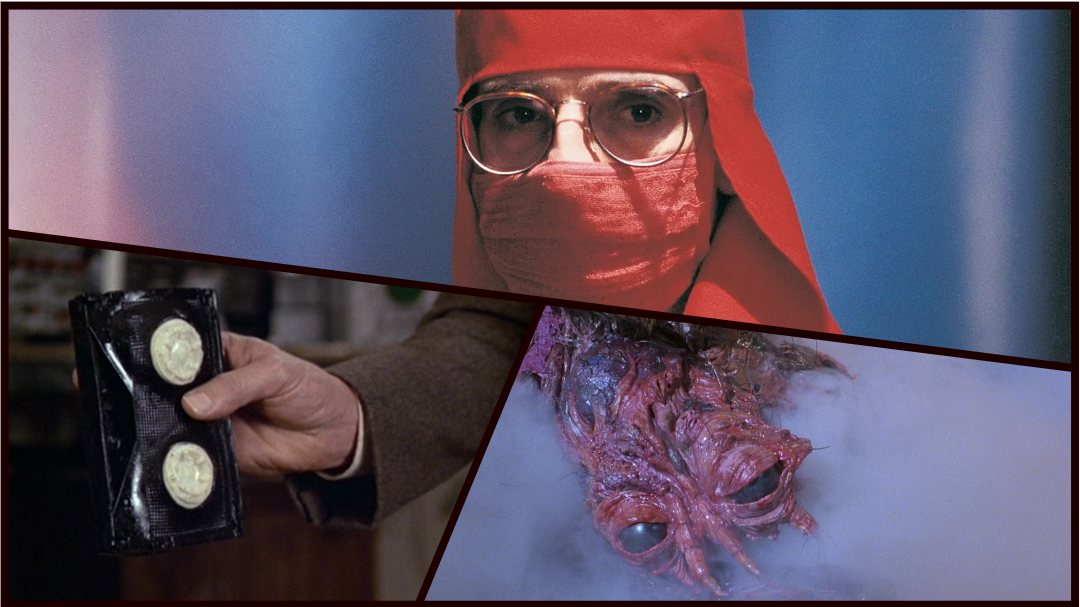
While putting together this year’s 61 Days of Horror lineup, three distinct visions of body horror, tragic identity, and technological infection stood out: David Cronenberg’s VIDEODROME, THE FLY, and DEAD RINGERS.
Rather than letting them fade into the background of a packed spooky season schedule, I decided to dive deep into what fascinates me about these films. In this piece, I explore how Cronenberg uses the corruption of the flesh to lay bare our deepest anxieties and repressed fears about technology, disease, and identity.
Check out the rest of this year’s curated list on Letterboxd!
VIDEODROME (1983)
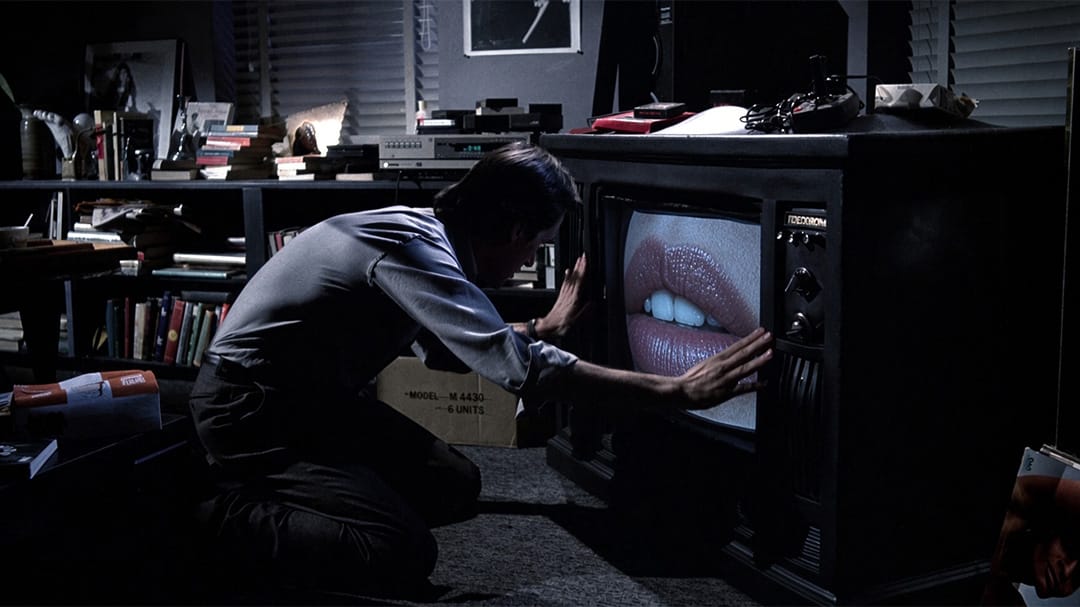
David Cronenberg’s techno-surrealist VIDEODROME stars James Woods as Max Renn, the president of CIVIC-TV, a scrappy Toronto UHF station scraping the bottom of the dial for whatever’s nasty enough to keep the ratings up. Max is hunting for something truly depraved—something that’ll cut through the softcore clutter—and he finds it in an illegal, unencrypted satellite feed broadcasting torture and murder.
That signal is Videodrome. Max is hooked. So is Nicki Brand (Deborah Harry), the sadomasochistic radio host he’s sleeping with. One episode and she’s turned on enough to hop a plane to Pittsburgh, where the show supposedly originates, to audition. She never comes back.
Desperate for answers, Max leans on Masha, a softcore pornographer with connections. What she tells him lands like a gut punch: the footage isn’t staged. It’s real. And it’s part of something much bigger—and far more lethal—than a snuff broadcast. At the center is Brian O’Blivion, the enigmatic media theorist who speaks only through pre-recorded videotapes.
O’Blivion knows the truth. Spectacular Optical—the company that makes eyeglasses and missile-guidance systems—is running Videodrome as a delivery system. It’s a moral crusade dressed up as programming, beaming a hallucination-inducing signal that cooks up brain tumors and turns viewers into programmable hardware. The goal? Purge anyone deemed too perverse to exist in the new world.
Max’s body becomes the battlefield. A wet, vaginal slit opens in his stomach—a wound that doubles as a tape deck—where brainwashing Betamax tapes can be inserted. Max isn’t watching Videodrome—he’s being programmed by it; rewritten by it.
His handgun fuses into his palm until the weapon and the hand are one organ. The television set swells and breathes toward his face like something alive, and he presses into it. By the end, Max isn’t a passive viewer. He’s the media, the player, and the weapon. Whoever holds the remote holds him.
Brian O’Blivion, television prophet, lays it out clean:
“The battle for the mind of North America will be fought in the video arena: the Videodrome. The television screen is the retina of the mind’s eye. Therefore, the television screen is part of the physical structure of the brain. Therefore, whatever appears on the television screen emerges as raw experience for those who watch it. Therefore, television is reality, and reality is less than television.”
Watching VIDEODROME again in 2026, what hits hardest is that the “retina of the mind’s eye” isn’t shared anymore. Everyone’s growing their own. No two people’s raw experience of “the news,” of “what’s happening,” overlaps enough to even argue about—because nobody’s being shown the same thing to begin with.
O’Blivion saw a monoculture coming, one signal rewriting everyone at once. What we’ve got now is worse: a million bespoke microcultures, tailored to the individual, engineered by systems that profit from keeping us divided.
Videodrome's producer, Barry Convex (Les Carlson), was the prototype for men like Elon Musk, Peter Thiel, and Mark Zuckerberg: technocrats who want to own the airwaves, tune the frequency to their own politics, and feed us curated hallucinations until nobody can agree on what’s real.
In 1983, Cronenberg warned that television could rewrite the mind. In 2026, the screen (phone, tablet, laptop, whatever’s in your hand) isn’t just the retina of the mind’s eye. It’s an extension of the self—new flesh, fused to our palms the way the gun fuses to Max’s—owned and operated by the wealthiest people alive, optimized to keep us distracted and doomscrolling while they engineer how we think and feel.
Brainwashing us with bio-organic Betamax tapes feels almost quaint now. The signal’s the algorithm. Don’t forget to like, subscribe, and smash that notification bell for more awesome content, and long live the new flesh.
THE FLY (1986)
In 1980, Mel Brooks handed a Victorian melodrama to David Lynch, the man who made ERASERHEAD. Six years later, he handed a creature-feature remake to the man who made VIDEODROME. Both times Brooks kept his own name off the picture so nobody would walk in expecting jokes. Both times, a fringe director delivered one of his most openly emotional films.
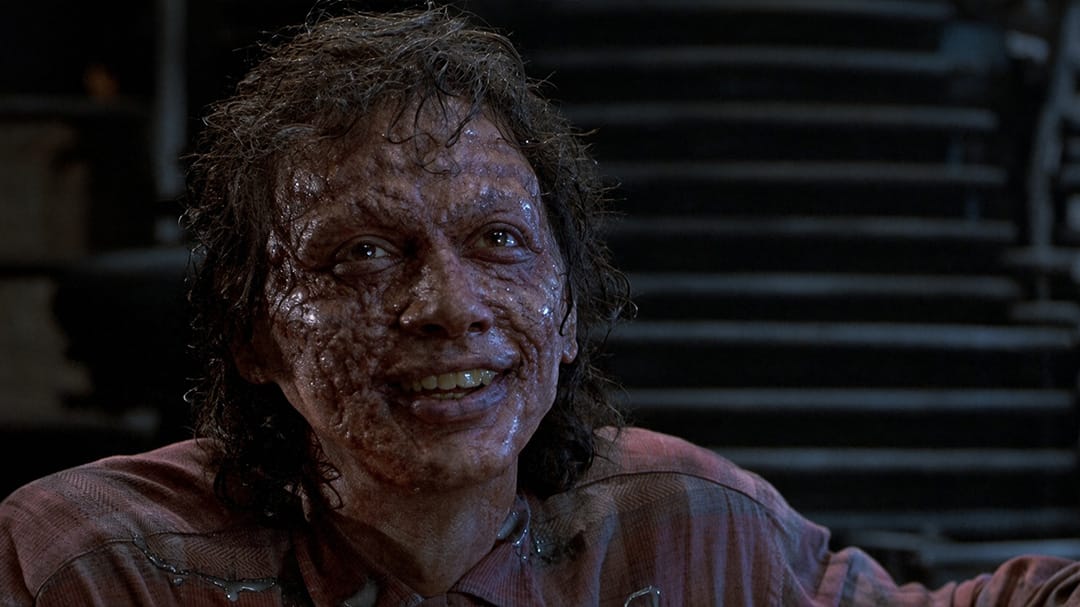
THE ELEPHANT MAN and THE FLY are siblings. Two Davids, Lynch and Cronenberg. Two deformed men, John Merrick and Seth Brundle. Two performances, from John Hurt and Jeff Goldblum, that have to travel through layers of prosthetics on nothing but voice and eyes, and arrive intact. There’s even a direct line between the makeup chairs: the outcry over Christopher Tucker’s unrewarded work on Merrick pushed the Academy to create its Best Makeup category, which Chris Walas and Stephan Dupuis later won for Brundlefly.
Seen young, THE FLY ambushes you with empathy: a brilliant man consumed by ambition, ravaged by disease, and slowly transformed into a monster, and you can’t stop rooting for him. It’s a horror movie, sure, but first it’s a three-character chamber drama about terminal illness—a love story with a countdown clock.
Put the two men’s signature lines side by side, and the films split apart.
“I am not an animal!” Merrick cries, cornered in a train station.
“I’m an insect who dreamt he was a man and loved it,” Brundle says. “But now the dream is over... and the insect is awake.”
Same subject, opposite verdicts. Merrick is introduced as a monster and revealed as a man. Brundle is introduced as a man and revealed, piece by piece, as a monster. Lynch’s film is spiritual at heart: the body is a cruel shell and the soul inside will one day be set free. Cronenberg doesn’t believe in the soul. For him, the flesh is the self, so when the flesh changes, Seth changes with it, including his appetites, his ethics, and his mercy. Merrick can insist on his humanity because, in Lynch’s universe, it’s true. Brundle can’t, because in Cronenberg’s it isn’t.
Merrick did nothing to earn his suffering. Brundle did it to himself. The catastrophe doesn’t come from grand mad-scientist megalomania; it comes from ordinary human insecurity, too much to drink, and a petty spike of jealousy over an ex. Early on, the change feels like liberation (strength, stamina, manic confidence, the “plunge into the plasma pool”), disease masquerading as transcendence before the fingernails fall off.
Brundle is honest enough to warn the woman he loves, Veronica Quaife (Geena Davis), while he still can: “I’ll hurt you if you stay.” She becomes our surrogate and the film’s anchor—witness, caretaker, survivor—left to carry the psychological trauma of his transformation, embodied by her horrific maggot-birth nightmare (presided over by Cronenberg himself, who plays her gynecologist).
Yet even as Veronica watches him deteriorate into something alien, a battle rages inside Brundle: human intellect versus raw insect instinct. He keeps his scientific curiosity as he decays, cataloging his discarded body parts in the medicine cabinet as the “Brundle Museum of Natural History.” It’s gallows humor; perverse curiosity—the conscious mind desperately trying to document its own erasure.
By the final scene, that fusion of man and fly has been fused again, this time with the telepod itself: a crawling ruin of flesh, steel, and instinct with nothing recognizably human left. But when that ruin guides the shotgun barrel to its own head, human intellect steals back the wheel for one final second. A fly operates purely on instinct; it doesn't know it’s suffering, and it can’t ask for mercy. Whatever is making that request is the last flickering ember of Seth Brundle’s mind—an intellect bound to the flesh, fighting instinct until the very end.
Both Brundle and Merrick choose their deaths, and both times we’re relieved. The struggle is over. Nobody is in pain anymore. But Lynch gives Merrick an exit with a destination. The model cathedral he has been building is finished. He has been to the theatre. He has told his doctor, Treves, that his life is full because he knows he is loved. He acts alone, with his own hands, removing the pillows to lie down and sleep like everyone else, knowing it will kill him. The camera follows him out into the stars, toward his mother’s face and the promise that nothing really ever dies.
There are no stars for Brundlefly. No mother's face. Veronica has to pull the trigger, so the mercy costs her something, and the film leaves her on the floor, sobbing, as it cuts to black. The only comfort is that it’s over.
Lynch says the man outlives the body. Cronenberg says the man is the body—a fusion of human intellect and animal instinct that's worth weeping over anyway.
DEAD RINGERS (1988)
Before DEAD RINGERS, Cronenberg was celebrated (and occasionally dismissed) as a master of low-budget schlock horror, famous for exploding heads, bio-mechanical tape decks, and mad scientists. But in 1988, he turned his gaze inward. The result wasn't a monster movie, but a deeply mournful, clinical tragedy about the impossibility of individual identity and what Cronenberg called the grief of “unrequited life.”
Inspired by the bizarre 1975 case of Cyril and Stewart Marcus—identical twin gynecologists who were found dead, decaying, and semi-naked together in their trash-strewn Manhattan apartment after a mutual spiral into narcotics—DEAD RINGERS strips away the typical tropes of genre cinema. There are no supernatural curses, no sci-fi splices, and no "good twin / bad twin" cliché. Instead, Cronenberg treats identical twins as a cruel twist of biological fate in which one identity is accidentally split into two bodies at conception, leaving both halves unable to survive on their own.
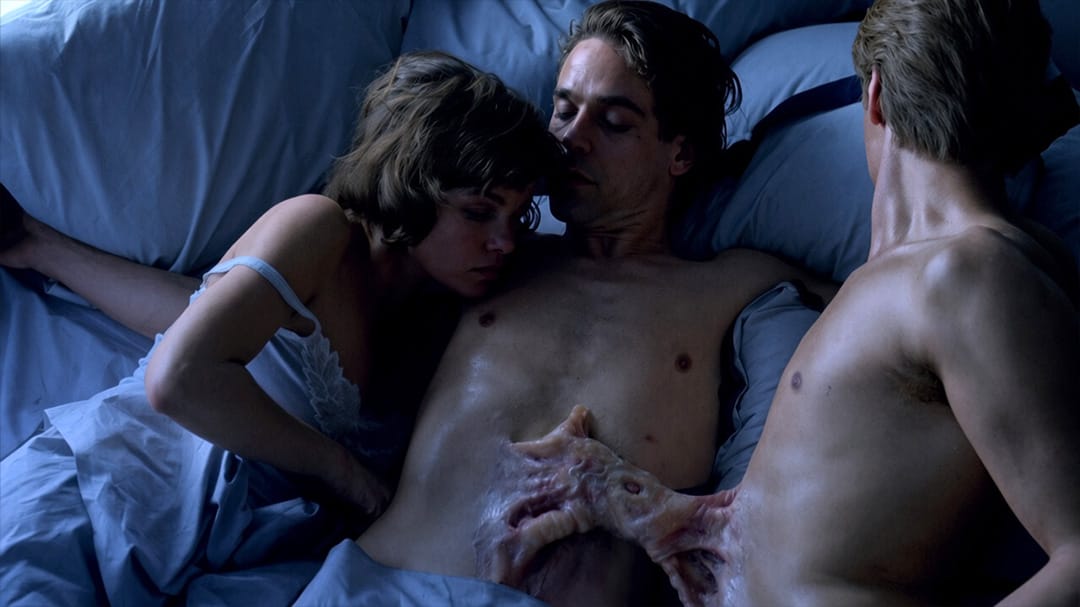
Jeremy Irons delivers a career-defining dual performance as Elliot and Beverly Mantle, acting not behind latex prosthetics, but through subtle shifts in posture, vocal rhythm, and a dark flicker of vulnerability behind the eyes. Together, the Mantle twins run a world-renowned fertility clinic. Elliot is the arrogant, charismatic public face—an extrovert who delivers speeches, claims credit for their medical breakthroughs, and seduces women before quietly passing them off to his introverted brother like hand-me-downs. Beverly is the hidden research genius—a fragile, reclusive introvert who actually does the intellectual heavy lifting in the lab.
Neither man is a complete human being. They exist as a closed-circuit organism, sharing their practice, apartment, accolades, and lovers. They treat the external world—and specifically the female body—as an engineering puzzle to be mapped, solved, and mastered.
That closed circuit fails when actress Claire Niveau (Geneviève Bujold) enters their clinic. Upon examining her, the twins discover a rare anatomical variation: a trifurcated cervix. Claire represents a body that defies their standardized medical diagrams, exposing the limits of their clinical hubris. But more destructively, when Beverly falls genuinely in love with her, he tries to claim an experience he can't share with Elliot.
Beverly’s attempt to establish an individual self outside the twin dynamic triggers a catastrophic psychological collapse. Unable to navigate an independent identity, he spirals into severe narcotic addiction. Yet, because the Mantles share a single psychic architecture, Elliot cannot simply detach and save himself. To preserve their bond, Elliot actively takes the same drugs, declaring their tragic mandate:
“Beverly and I just have to get synchronized. Once we're synchronized, it'll be easy.”
Their mutual degradation manifests as a horror of male hysteria and medical panic. Distorted by delusion, Beverly perceives human women as "mutants" whose bodies are turning against him. He commissions a metallurgical artist to forge a set of alien-like surgical tools—“instruments for operating on mutant women”—turning the sterile, brightly lit operating room into a terrifying theater of madness, complete with crimson surgical gowns that resemble liturgical vestments.
Using his "mutant instruments"—now repurposed as tools for separating conjoined twins—Beverly performs a brutal, fatal operation on Elliot in their darkened clinic. It is simultaneously a murder, a suicide, a surgical extraction, and a perverted expression of love. When Beverly wakes from his drug stupor the next morning, finds Elliot’s corpse, and wanders out into the cold world, he realizes the truth: without Elliot, he does not exist. He stumbles back inside, crawls onto his brother’s body, and dies in his arms.
Cronenberg offers no catharsis, no spiritual transcendence, and no comfort after the screen fades to black. DEAD RINGERS succeeds as a profound and tragic horror story because it refuses to treat the Mantles as monsters. It sees them as rare, fragile creatures whose destinies are intertwined and inescapable—who attempt to play god and pay for it with their l̶i̶v̶e̶s̶ life. In death, they are inseparable. For the first time since they shared a womb, they are whole.
🍕 POP 'N' PIZZA is your deep-dish slice of pop culture's weirdest, most esoteric corners—served with extra sauce and a side of existential dread. Written by Adam Frazier.