G O L D I E S: T H R E E
It’s curious. It’s patient. It’s growing. Told without dialogue, GOLDIES follows an excavation crew that uncovers a mysterious relic left buried by their ancestors—one that was never meant to be found.

P A R T T H R E E
Lower levels, where the station shows its age plainest — pipe insulation gone brittle at every seam, strip lighting cycling on a flicker nobody's had the hours to fix. A work order sits open on a data-slate: motion sensor, sublevel access shaft, malfunction, bumped down the priority queue three cycles running behind everything else currently wrong on this station.
A Goldie follows the ticket alone, tool bag over one shoulder, unhurried — this deep into a station's service life, sensor glitches are usually just that. Vermin, maybe, working into the wiring the way vermin always eventually do on a hull old enough to have seams worth finding. An annoyance. Not a reason to call it in as anything more.
Something skitters ahead in the dark, low and quick, gone before a handlight catches more than a suggestion of it. The Goldie grips the spanner a little tighter — not from fear, more the old reflex of a hand that's dealt with pests before — and follows the sound instead of the ticket now, footsteps quick against the decking, throwing echo back off walls too narrow to hold it.
The passage dead-ends in a service alcove, conduit boxing it in on three sides, beaded with condensation from a coolant line running low along the ceiling. And there, folded into a space too small for it, backlit faintly by its own dim inner glow, is the creature — larger now than any entry in that half-empty case file, vine and leaf and small unopened buds knit into a shape that holds almost, but not quite, still.
The Goldie raises the spanner. Whatever this is, cornered, ought to bolt.
It doesn't. It goes stiller instead — and then it starts, slowly, to come apart and remake itself. Vines slacken and re-knot. Leaves fold into new lines, find new edges. The four-legged shape rises, lengthens, and resolves into something upright: two legs, two arms, a head tilting at a familiar, considering angle.
A face assembles last. Woven petals gather into the exact black, depthless shape of eyes — the same eyes a dig team knelt before months ago and recognized, without a word, as their own. The Goldie's hand, without any decision behind it, drifts toward the figure's cheek, stops, then pulls back to touch its own.
The figure lifts one arm. Vine and tendril knot themselves into something with digits — an open hand that extends into the narrow space between them, palm up. Steady. Unhurried.
The tool goes first, clattering off the decking. Then the Goldie, running, boots hammering back the way they came, until there's nothing in the alcove but the low hum of the coolant line and the shape, already unknotting itself, unoffended, folding back into the gap it sprouted from.
At a terminal several decks up, a report comes in fast and half-coherent, and a case number that's sat open since a lab incident months ago gets one more line appended beneath all the others. The status field remains the same. Ongoing.
Elsewhere, the shape, back on four legs, makes its way along the base of a dim cargo hold and works itself into the gap behind a stack of storage containers — out of the light, out of the way, exactly where no one looks. There, it begins to curl.
Vine draws in against vine. The oldest, outermost growth folds inward first, closing over everything beneath it the way a hand closes over something it means to protect. What was open and reaching only an hour ago collapses by degrees into something small, tight, and round — knotted in on itself until no shape remains that reads as a creature at all.
Color drains out next. Green fades to dull brown. The small buds, never opened, wither at the edges and pull flush against the rest. The faint light that has pulsed the length of its body since the lab table thins, flickers, and goes dark — not slowing gently this time, but switching off.
What's left, wedged behind the containers, looks exactly like what the next crew member will assume it is: a dead clump of refuse, the kind of thing swept up without a second glance and thrown out with the rest.
In the cargo hold, behind the same stack of containers no one has moved in weeks, the dead thing stirs.
It doesn't happen slowly this time. What took hours to wither takes less to reverse. The tight brown knot swells, splits along its own seams, and begins to unfurl — vine finding vine, leaf finding light. Color returns from the inside out, a green so deep it reads almost black at first, then brightening by the second. The pulse that guttered out and went dark doesn't simply resume; it surges — a brilliant luminance — and holds there, unwavering, like something that has finally stopped conserving energy and is ready to use it.
Where there was reed and stem, there is now something closer to bark — deep-ridged, dense, holding its shape under its own weight rather than needing the air to hold it up. Four legs have become two, planted wide, built for standing tall rather than slinking around. Where vine once tapered to a point, limb now thickens toward something like a shoulder, an elbow, a wrist — heavier at the joints, the way a trunk thickens toward its base. The small, shy buds that never opened have gone to full flower and past it, deepening from green into a rich, burnished gold — autumn's color, on a station that has never once seen a season change. Layered down its chest and limbs, the bark takes on a ridged, plated look, so that from a distance, down a long corridor, in bad light, it reads — for one full, held breath — as a Goldie in an old-style envirosuit. Reflective. Gold-tinted. Exactly like the ones that first found it.
Its face gives the resemblance away, and confirms something else entirely. There's no visor here, nothing to catch the light and throw it back. Where the woven, blinking approximation of eyes once sat, there are now simply eyes — solid, black, and alive. They no longer have to be understood as an imitation of anything. It blinks because it wants to blink. It looks because it is looking.
Heavy and deliberate, it leaves the cargo hold on two legs and does not go quietly, because it no longer needs to.
Word travels ahead of it, decks before it arrives — a shape too large for any vent, moving in the open, down the widest corridors instead of narrow ventilation shafts. Technicians freeze at junctions rather than radio it in. A scientist, halfway through a routine sample log, sets the sample down without finishing the entry and watches it pass, mouth open, making no move to stop it, to touch it, to do anything at all but witness it. No alarm sounds. No one reaches for a weapon, a comm, a protocol. The instinct that has carried this crew through every drill of their working lives — report it, contain it, follow procedure — goes quiet in the presence of something that doesn't ask to be contained.
It isn't fear that holds them still. Whatever this is, standing in a hallway built for cargo pallets and maintenance carts, doesn't read as a threat so much as an arrival — the kind of thing a person kneels for instinctively, before they've decided whether kneeling makes any sense.
Deck by deck, it climbs toward the one room on this station built to older lines than the rest of it — repurposed rather than replaced, the way everything out here eventually is — and doesn't knock, because the door is already standing open, because whoever is inside has been watching its approach on every camera still working, long before it reaches the threshold.
The Overseer doesn't call for security. Doesn't reach for anything on the desk — not the ledger, not the terminal, not the data-slate, the same one that logged this discovery back when it was still just cargo, back before it had a face. The Overseer stands straight, still, compelled to witness what may be their oblivion or their evolution.
The figure fills the doorway. Then it steps through.
One arm lifts — bark-ridged, gold-leafed, heavier now than the last time it made this exact gesture, in a different corner of the station, to a different Goldie who ran. The Overseer doesn't run. The Overseer's hand rises to meet it without hesitation, the way a hand rises to shake another hand, or to touch the cheek of a statue.
Their hands close together.
For a moment, nothing else happens. Two figures stand just inside the threshold, joined at the hand, as still as the temple statuary that started all of this.
Then, beneath the skin of the Overseer's wrist, something moves.
Nothing about the stillness in the Overseer's face suggests pain, or panic, or any struggle at all — only a kind of loosening, the look of someone finally setting down a weight they've carried for far too long. A thin green vein threads up under the skin of the forearm, following the path a real vein would, indistinguishable from one at a glance, and keeps going — past the elbow, along the bicep, over the shoulder, under the collar. It doesn't tear its way through. It moves like water through a system built to carry it, finding the paths already there and using them.
The Overseer's eyes are the last thing to change. A thread of green catches behind the black and holds there, low and steady, pulsing with luminance. The hard, downward pull at the corners of the Overseer's mouth unspools. Their jaw slackens, tight lips parting on a soft, shuddering exhale as the strain of a lifetime finally gives way. What replaces it is an effortless, quiet curve — a smile born of total release, and beneath it, something vast and warm the Overseer has no word for, a feeling their species was never quite built to carry. Held now, forever, in the embrace of a living god.
What happens next isn't a single event so much as a slow, station-wide exhale. Seen all at once — the way no single crew member ever will, but the way a cutaway of the station would show it, deck stacked on deck, corridor threaded through corridor — the pattern becomes unmistakable. Thin veins of green run alongside every cable and coolant line the station already had, tracing the exact architecture of a nervous system that was, this whole time, sitting one layer beneath the wiring.
In the mess hall, a technician sets down a cup mid-sip and doesn't pick it back up; a slow thread of green settles behind black eyes, still sitting upright, posture composed. In a berth three decks down, a scientist rolls over in sleep and doesn't wake the rest of the way, breathing slow and even, a thread of green already tracing one exposed forearm. In the sublevel where a lone Goldie once dropped a tool and ran, the tool sits where it fell — and a green thread runs along the floor beside it, unbothered, headed the same direction everything else on this station is now headed.
No one screams. No one runs. It moves through the crew the way water moves into dry ground — not an invasion so much as an absorption, the station and everyone still breathing in it becoming, deck by deck, less like separate things and more like the same thing.
Every Goldie the growth has touched stands, or sits, or lies exactly where contact first found them, still and rooted, more furniture now than crew. The growth reaches the comms bay the way it reached everything else: a single tendril, thin as wire, threading up through a ventilation duct, feeling its way along the inside of the panel housing — patient, searching, until it finds an edge worth closing around.
It finds the switch, built for exactly one purpose and never once used in this Overseer's tenure, and curls around it the way it would curl around any other narrow, well-placed thing worth holding onto.
Then it pulls.
Somewhere on the hull, a single light that has sat dark since before this crew arrived begins to blink — a slow, even pulse, carrying a signal built to be heard from very far away.
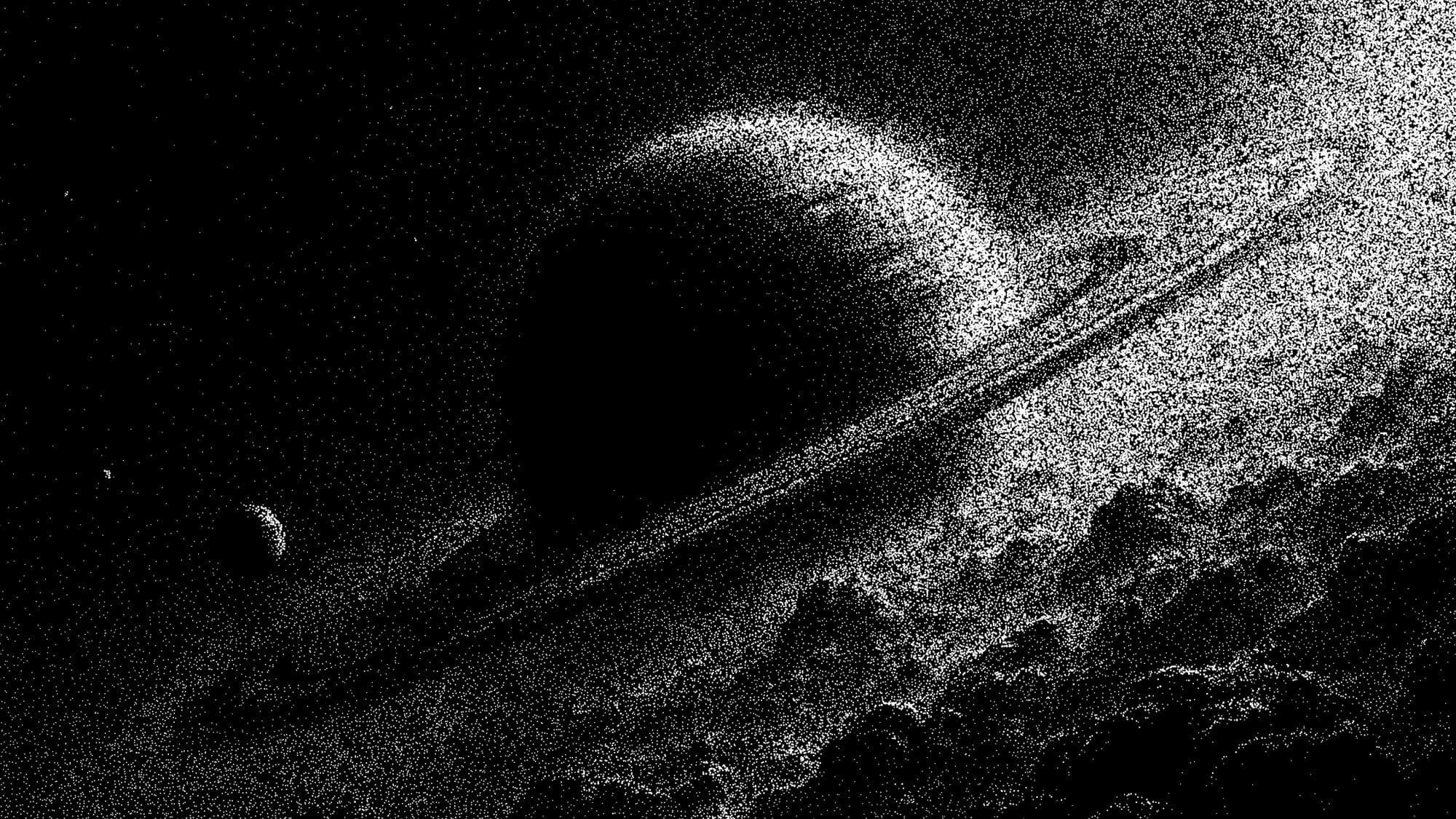
The station holds its position, same as it always has, tucked among the ice and dust of the rings, lights blinking steadily against the dark — one more light now than there was an hour ago. The gas giant fills the sky around it, banded and vast, slowly turning on the same axis it always has, and will keep turning long after the station's gone.
The signal doesn't need an answer today. A month from now, a year, a century — whenever it finally reaches someone within range to catch it — what they'll find is a structure grown wild past recognition: corridors softened under moss, consoles buried beneath a weave of vine and stem, root and cable grown together. Not a space station in distress, but a garden, lush and flourishing, wearing the shape of one.
Some will come to help. Others, to help themselves. Either way, they'll come — and with them, they'll bring everything needed for life to spread: air worth breathing, water worth drinking, and more room, always, to grow into.
Space. Stars. Silence.
🍕 POP 'N' PIZZA is your deep-dish slice of pop culture's weirdest, most esoteric corners—served with extra sauce and a side of existential dread. Written by Adam Frazier.