G O L D I E S : O N E
It’s curious. It’s patient. It’s growing. Told almost entirely without dialogue, GOLDIES follows an excavation crew that uncovers a mysterious relic left buried by their ancestors—one that was never meant to be found.

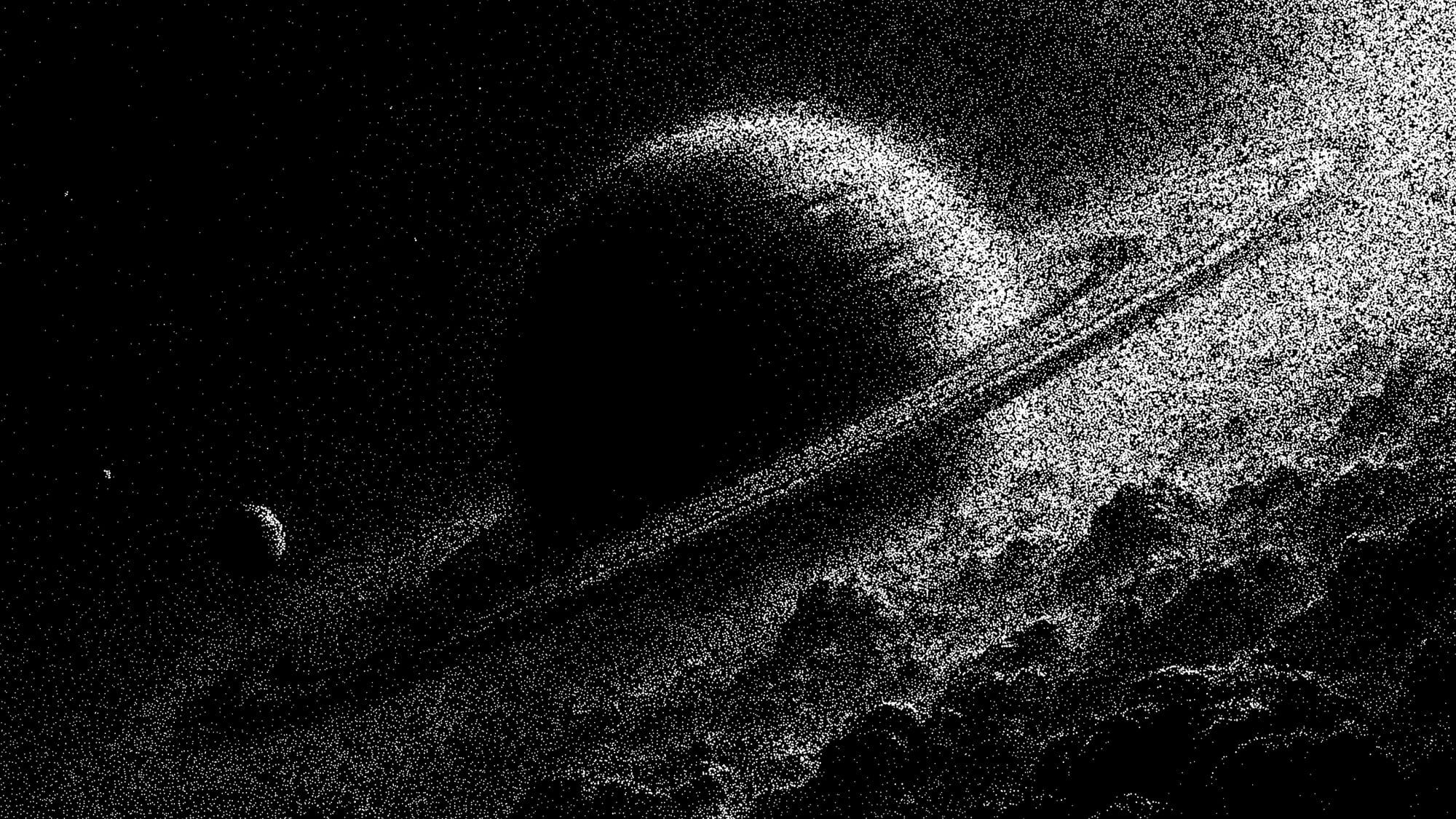
P A R T O N E
Space. Stars. Silence.
A small planetoid, lavender and pitted with craters. A ship rests on a mesa, hull scorched and scarred, plating patched over corrosion, markings sun-bleached beyond reading. Cables thick as tree trunks spool down into a crater — sheathed in resin gone brittle at every joint. They pulse faintly where they vanish into the dark. Less like power lines. More like feeding tubes.
But the crater isn't a crater. It's a wound, torn open in the shape of an ancient structure — colonnades still standing in long rows, half-buried, fluted like something grown rather than built. Obelisks lean at odd angles, cut from a black stone that drinks the light instead of throwing it back. Near the crater's lip, a marker stake leans off true. Below it, the ruins spread out like the bones of something long dead — and Goldies move among them in black spacesuits, small as insects against the scale of it all.
A structural read comes back on the main passage — sound enough, for now. A reading this crew has learned not to fully trust, after enough years being proven wrong by ground that looked solid.
They go down anyway. The light narrows, then vanishes. Corbelled ceilings stack overhead in interlocking rings, like vertebrae. Helmet-lamps cut narrow beams through the dark, dust hanging undisturbed in them, suspended in air no one has moved through in longer than anyone can guess.
Somewhere in the descent, a suit readout blinks a quiet confirmation none of them expected — oxygen, nitrogen, trace elements, close enough to home to be unsettling. Warmer, too, than a place buried this deep under rock has any right to be. Condensation beads along the corbelled stone overhead, and where it gathers and drips, threads of pale green have taken hold in the cracks — something like moss, growing where nothing should be growing at all.
The first chamber opens low and wide. Urns and statuary line the walls — rank after rank of golden figures, seated in ceremony, palms lifted to the heavens, eyes and awe-struck faces tilted in one direction: up. An astronaut kneels before a half-buried figure and brushes dirt from its face, one slow, delicate stroke at a time. Gold scales emerge, catching the light. Eyes set deep — obsidian, polished to a black glass sheen. Depthless.
The astronaut sits back. Unlatches its helmet before anything else — lifts it free, sets it down in the dust. A breath in. Then out. Nothing happens. A glove is removed; a hand with four long digits rises to the statue's cheek — cool stone, unmoving — before pulling back to touch their own. Gold skin under bare fingers, eyes fixed on the statue's — the same impenetrable black. The others gather, one by one. No one speaks. They don't need to. The face in the stone is the face under every helmet at this dig site.
A data-slate flashes. Then wails. A biometric signature, faint but unmistakable. The Goldies move as one, deeper into the passage — past glyphs cut in spiraling bands, past statuary standing sentinel in the dark, waiting just beyond the light. An excavator peels back a final layer of stone, revealing a sealed chamber beneath. Its arms clear the soil with surgical care. A second machine, pincered and patient, reaches into the dark and lifts something free.
A shape, easily the length of two Goldies laid end to end. Its shell is a deep, iridescent jade, seamless in places, ridged in others, like no vessel and no creature at once. A tech fixes a catalog tag to the containment webbing without looking up, muscle memory before thought. The machine turns the shape slowly. No one moves. No one breathes.
It's warm. Even through the suits, they can feel it. And beneath the shell, something moves.
Later.
A pale blue gas giant, wrapped in shimmering rings, turns slowly around twin suns. Tucked among the ice and dust of the bands, a space station holds its position — a stepped pyramid, tiers narrowing toward a single spire at its crown. Gilded trim, dulled now to tarnished bronze, still traces the edge of every tier. Clusters of add-on modules crowd the lower levels and docking arms jut out at odd angles, interrupting the original symmetry. Corrosion bleeds down every seam. Lights run the length of it unevenly — one whole tier gone dark and left that way.
Inside, the Chrysalis lies strapped to an examination table beneath the flat wash of fluorescent light, a containment tag fixed to its cradle without ceremony — the latest intake number in a sequence that reaches back further than anyone aboard can remember. Whatever stirred inside it on the planetoid has gone still. Around the table, Goldies in black hazmat suits move with the unhurried precision of those who've done this before — and learned, the hard way, what precision buys you out here.
A tech draws a laser scalpel across the shell in one long elegant pass. The beam scores a hairline groove. Nothing more. A second pass. A third. The shavings are swept into a shallow dish, labeled, set aside for later study — one more line in a file that will outlast the people writing it.
A scientist steps in with a single glass eyedropper. One drop of red fluid falls onto the shell. It hisses. A thread of smoke curls upward, and where the acid touches, the jade begins to blacken and give way.
The cracks come fast after that — spreading, branching, threading across the surface like frost on glass. A fault line vents first. Then another. Thin ribbons of jade-green mist curl out from the cracks, catching the fluorescent light like smoke through a projector beam. An alarm cuts through the lab — the same tiered chime this crew has drilled against for years, the kind that used to mean something specific before this shift, before this table.
The shell splits along its length in one motion — not shattered, but opened, like something unlocking from the inside. The mist pours out in a sudden bloom, thick and low, rolling off the table and swallowing the room in haze. Technicians stumble back. A tray of instruments goes clattering to the floor. Someone shouts for the vents, for the doors, for anyone to see through the murk — but there's nothing to see. Just the mist, and shapes moving blind inside it.
Gloved hands go instinctively to seals and seams, checking suits, checking each other — the reflex of people who know their gear is rated for this, and still don't quite believe it, not after everything else this station has already asked that gear to hold back.
It takes almost a full minute to clear. The overhead lights flicker once, then steady. On the table, the Chrysalis sits empty, split open like a husk, its inner walls slick and glistening. A faint trail leads off the edge and into the shadow beneath it — already cooling. Already gone.
Somewhere down the corridor, a door that should be sealed hisses open. Then shut. At a terminal no one's watching, the incident logs itself under the only status the system has for something like this.
Ongoing.
TO BE CONTINUED... NEXT WEEK
🍕 POP 'N' PIZZA is your deep-dish slice of pop culture's weirdest, most esoteric corners—served with extra sauce and a side of existential dread. Written by Adam Frazier.