While the World Burns: Volume III
A film series covering 80 films from 1959 to 1989, from the waning days of the studio system through the early tremors of New Hollywood to the excess of the '80s.

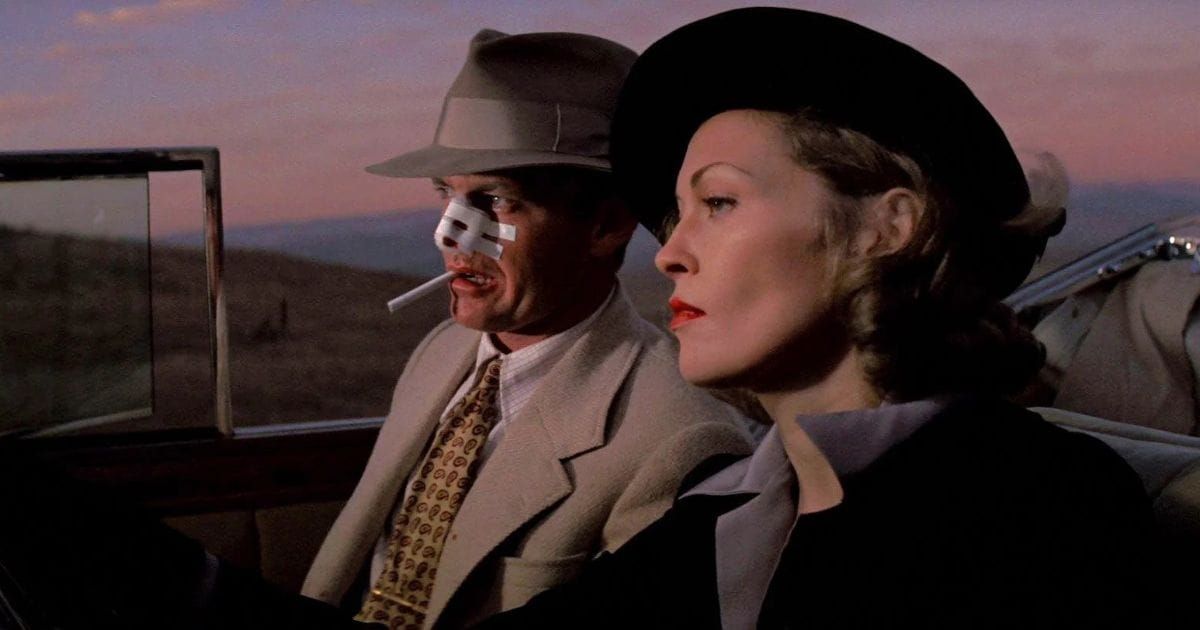
Watergate. Nixon's resignation. The fall of Saigon. The Senate Church Committee. Between 1973 and 1975, the American government's darkest machinery was dragged into the light — and nobody liked what they found. These fifteen films — released in the middle of all of it — were made by filmmakers watching the same news, reading the same papers, absorbing the same slow, reluctant revelation: that the institutions we had trusted were not what they claimed to be.
They responded accordingly. Fifty years on, these films read less like history and more like dispatches from a place we never managed to escape. The machinery of institutional rot, the corrosion of idealism, the vertigo of living inside systems exposed as lies — these movies understood that feeling first. And they're here for us now.
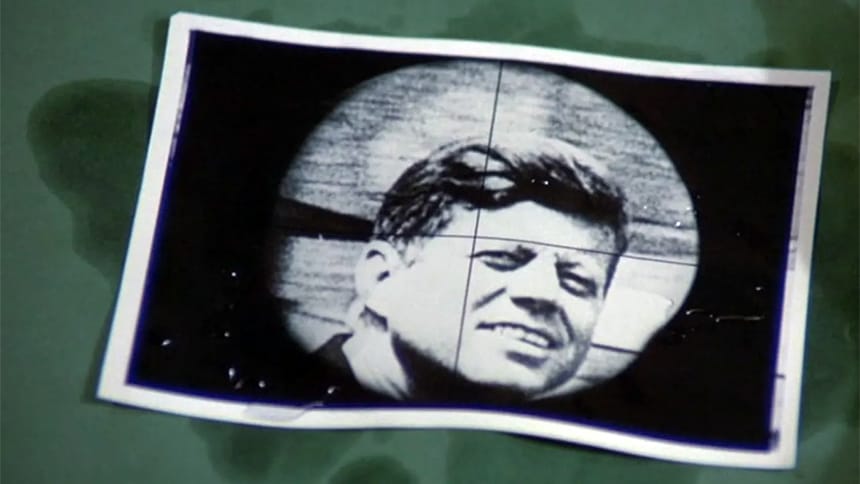
Executive Action (1973)
Dir. David Miller · DP: Robert Steadman · Cast: Burt Lancaster, Robert Ryan, Will Geer, Ed Lauter, Dick Miller
David Miller's lean conspiracy thriller was released in November 1973, on the tenth anniversary of the Kennedy assassination, and it still feels radioactive. Dalton Trumbo's script — written by a man who survived Hollywood's own blacklist — treats the assassination not as tragedy but as logistics: a problem to be solved by men in suits who speak in euphemisms and never raise their voices. Robert Steadman's cinematography keeps everything shadowless and institutional, drowning the frame in the fluorescent, drop-ceiling sterility of mid-century corporate America — a look as deliberately affectless as the conspirators themselves.
Burt Lancaster and Robert Ryan — who died of cancer four months before the film's release, making this his swan song — play the architects of the plot with the bland efficiency of middle managers approving a quarterly budget. Dick Miller, the great character actor of a hundred low-budget films, turns up as one of the triggermen, small, chilling, and entirely without flourish. Released a full eighteen years before Oliver Stone's JFK, EXECUTIVE ACTION was the first mainstream film to treat conspiracy not as unchecked paranoia but as plausible corporate procedure.
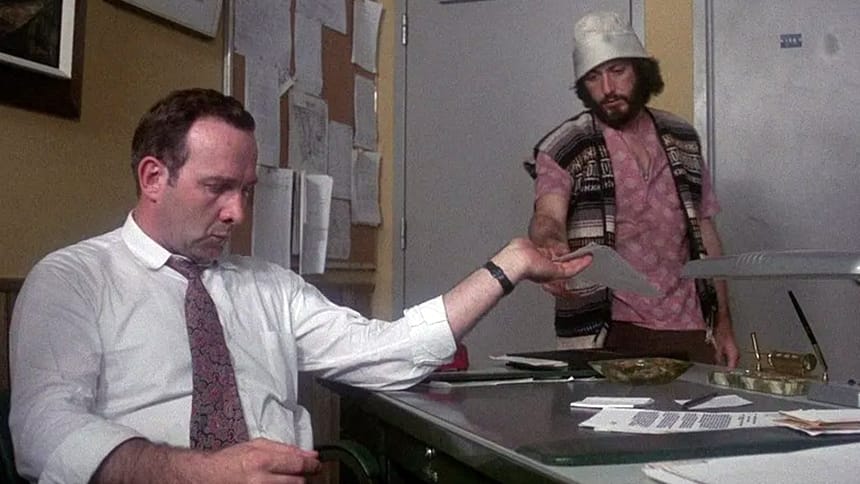
Serpico (1973)
Dir. Sidney Lumet · DP: Arthur J. Ornitz · Cast: Al Pacino, John Randolph, Jack Kehoe, Biff McGuire, Barbara Eda-Young, Cornelia Sharpe
Sidney Lumet puts Al Pacino's righteous fury under a microscope in this street-level dissection of systemic rot — a film that understands corruption not as villainy but as policy, a negotiated settlement between the men who hold power and the men who want to keep it. Pacino is a live wire as Frank Serpico, a cop whose hippie attire and counterculture sensibilities make him an alien in his own department — and a target the moment he refuses to take his cut.
Arthur J. Ornitz's gray, unvarnished New York strips away any lingering romanticism about the NYPD, transforming the city into a claustrophobic maze of institutional compromise where the most dangerous thing you can be is a man with a conscience. Lumet directs without sentiment and without editorializing — he trusts the facts, which are damning enough. Raw, deeply frustrating, and essential.
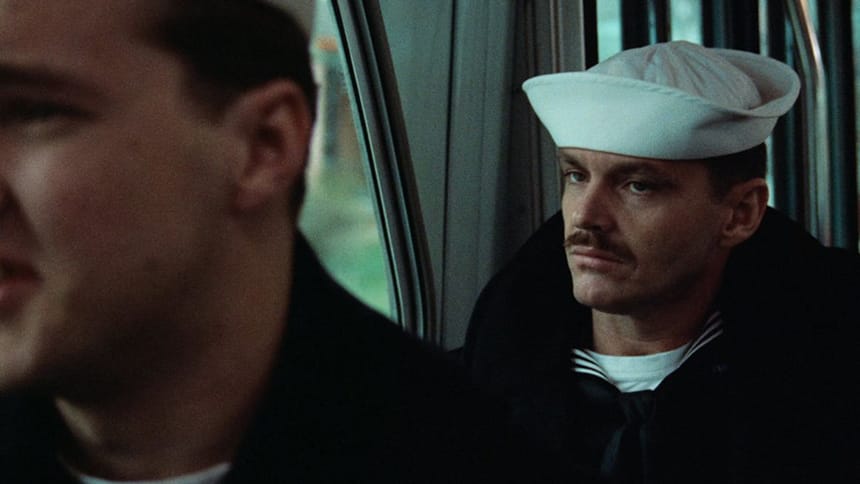
The Last Detail (1973)
Dir. Hal Ashby · DP: Michael Chapman · Cast: Jack Nicholson, Otis Young, Randy Quaid, Carol Kane
Jack Nicholson's most fully realized performance before CHINATOWN arrives in a film that shouldn't work on paper: two Navy lifers (Nicholson and Otis Young) escort a young sailor (Randy Quaid) across the winter-gray East Coast to serve eight years in military prison for stealing forty dollars from a charity box. Hal Ashby turns Robert Towne's profanity-saturated script into a bruising, comic tragedy about the gap between freedom and its appearance — these men are technically free, technically in charge, and completely trapped by the same system they're enforcing.
Michael Chapman's gritty, overcast cinematography captures a frozen, slush-stained East Coast, transforming wintry America into a vast holding pen without walls. Nicholson's "Badass" Buddusky is all roar and tenderness, a man who can't fix what's happening but refuses to pretend it isn't wrong. But beneath the beer-drinking and bravado lies a deeply melancholic story about the crushing weight of authority. You can carve out small, beautiful moments of rebellion and humanity within a broken system, but unless you are willing to break completely free of it, the house always wins.
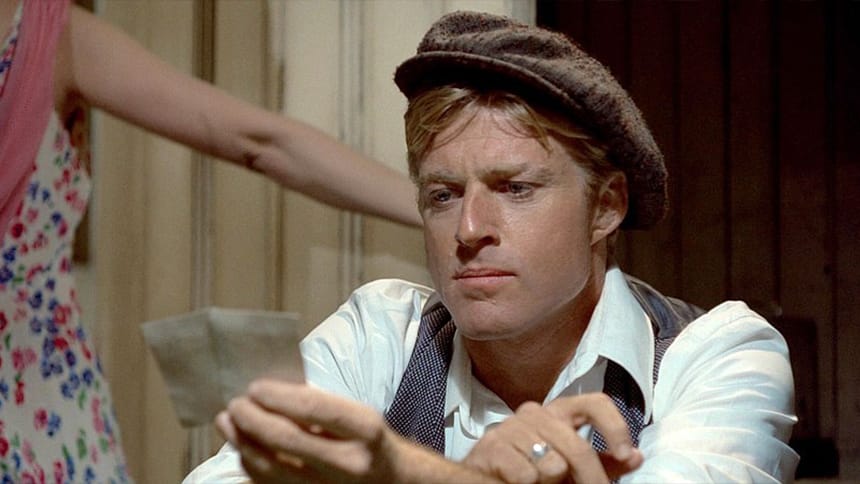
The Sting (1973)
Dir. George Roy Hill · DP: Robert Surtees · Cast: Robert Redford, Paul Newman, Robert Shaw, Charles Durning, Ray Walston, Eileen Brennan
George Roy Hill reunites the BUTCH CASSIDY AND THE SUNDANCE KID dream team of Robert Redford and Paul Newman for a meticulously constructed caper that trades the era's prevailing cynicism for pure, uncut cinematic showmanship. Redford's hungry street grifter and Newman's weathered master con man play off each other with a syncopated ease that mirrors Marvin Hamlisch's Scott Joplin arrangements, which won the Academy Award for Best Adapted Score.
Robert Shaw, playing against type as the mark, brings the film's only genuine menace. Robert Surtees's cinematography and the production design give Depression-era Chicago a sepia warmth that feels like nostalgia for a period the film is simultaneously dissecting. Winner of seven Academy Awards, including Best Picture, THE STING is the most crowd-pleasing film in this entire series — a beautifully calibrated Swiss watch of a movie that understands the best way to survive a rigged world is to become better at rigging it than the people who built it.
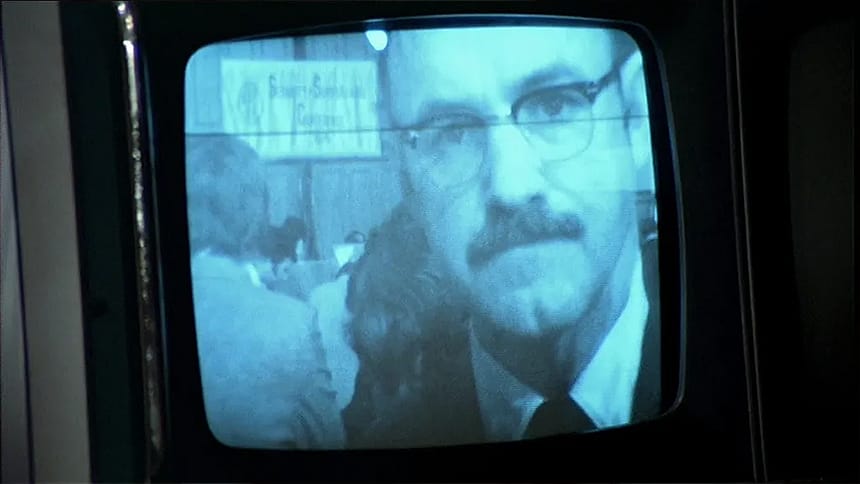
The Conversation (1974)
Dir. Francis Ford Coppola · DP: Bill Butler · Cast: Gene Hackman, John Cazale, Allen Garfield, Cindy Williams, Frederic Forrest, Harrison Ford, Robert Duvall
Released amid the Watergate scandal, Francis Ford Coppola's THE CONVERSATION is one of the great paranoid thrillers of the 1970s — cold, precise, and devastating in a way that has only grown more so as surveillance technology has advanced from tape recorders to smartphones. Gene Hackman gives one of the decade's finest performances as Harry Caul, a wiretapping specialist who begins to suspect that one of his recordings captures evidence of a murder plot, triggering a moral crisis that dismantles his carefully constructed isolation.
Bill Butler's cinematography maps out a world of glass cages and industrial warehouses, keeping the visual plane clinically flat. There are no expressionistic shadows here, no classic noir hiding places — which only makes the paranoia feel more inescapable. Walter Murch, who also co-edited the film, constructed what remains one of cinema's great sound designs: a soundscape that makes the act of listening itself feel like a violation. The supporting cast — John Cazale, Allen Garfield, Cindy Williams, Frederic Forrest, a young Harrison Ford — is impeccable throughout.
Made between THE GODFATHER and THE GODFATHER PART II, it may be the most personal film Coppola ever directed.
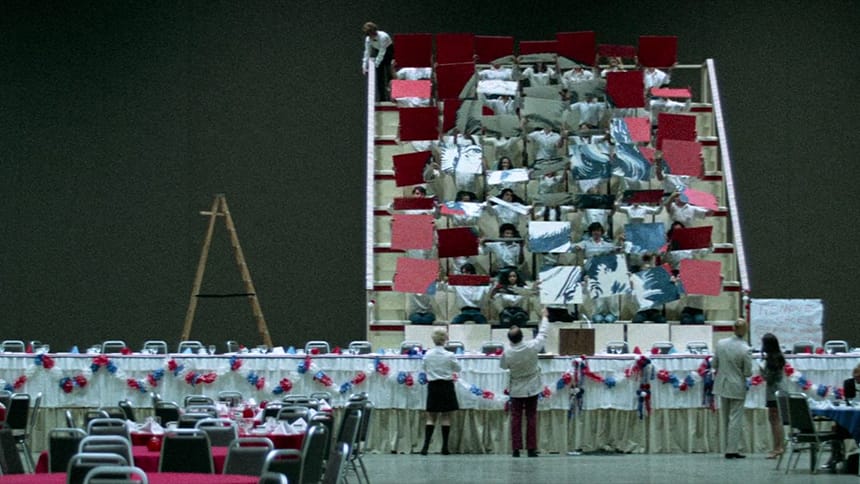
The Parallax View (1974)
Dir. Alan J. Pakula · DP: Gordon Willis · Cast: Warren Beatty, Paula Prentiss, Hume Cronyn, William Daniels, Walter McGinn
For decades, American cinema sold us the myth of the crusading lone wolf — the reporter, the detective, the whistleblower who pulls back the curtain and changes the world. THE PARALLAX VIEW, the centerpiece of Alan J. Pakula's "Paranoia Trilogy," exists to dismantle that myth with cold, geometric precision. Gordon Willis — shooting in the same shadow-heavy, wide-angle grammar he deployed on THE GODFATHER — uses vast, empty spaces and vertiginous compositions to make every individual look small and expendable against the monolithic structures of power. Warren Beatty's Joe Frady is the classic counterculture protagonist: cynical, clever, and deeply arrogant, convinced he can outsmart the Parallax Corporation by going undercover. But the system doesn't just anticipate him. It creates a space specifically designed for him to fill. His belief that he's the hunter makes him the perfect prey.
Paula Prentiss, Hume Cronyn, and Walter McGinn as the quietly sinister Jack Younger round out a cast that never tips into melodrama. From its shocking opening to the hypnotic Parallax Corporation "brainwashing" montage — six minutes of Americana, violence, and subliminal manipulation projected at a single man in a dark room — it arrives at a a bleak but inescapable conclusion: individualism is useless against institutionalized evil. Frady is swallowed alive by a corporate conspiracy so vast, so monolithic, and so shadowless it can't be found in plain sight.
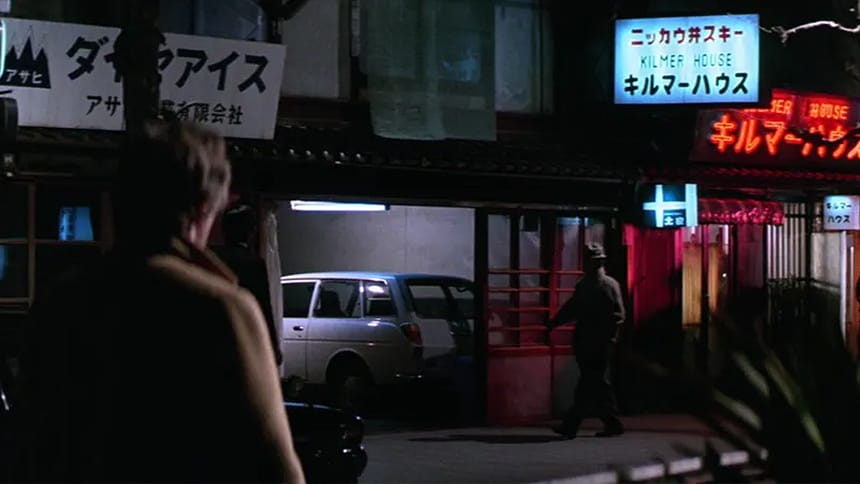
The Yakuza (1974)
Dir. Sydney Pollack · DP: Duke Callaghan · Cast: Robert Mitchum, Ken Takakura, Brian Keith, Herb Edelman, Richard Jordan, Keiko Kishi
Paul Schrader and Robert Towne wrote the script — two of the era's most gifted screenwriters working simultaneously on opposite ends of American disillusionment — and what they produced is something rare: a genre film with genuine weight. Sydney Pollack's cross-cultural collision of American noir and Japanese bushido is a story about obligation, dishonor, and the ghosts that follow wherever you may roam.
Mitchum plays a former GI drawn back to postwar Japan to rescue an old friend's daughter from the yakuza; Ken Takakura, one of Japan's greatest stars, plays his reluctant local partner with a quietness that makes every gesture count. Duke Callaghan's cinematography bridges the neon-drenched streets of Tokyo and the spare interiors of traditional Japanese homes with a visual language of displacement — two men from different worlds, bound by codes that neither world fully honors anymore. Bruised, melancholic, and formally elegant, THE YAKUZA understands that true honor isn't found in the kill. It's in the scars you carry for someone else.
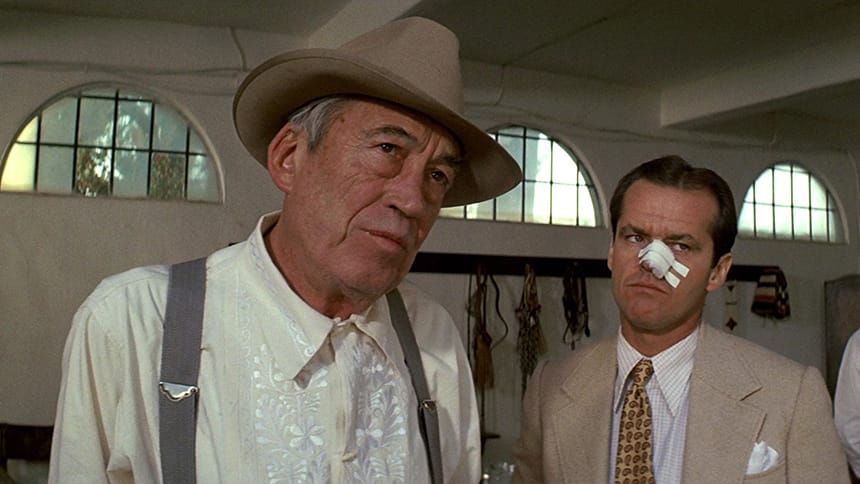
Chinatown (1974)
Dir. Roman Polanski · DP: John A. Alonzo · Cast: Jack Nicholson, Faye Dunaway, John Huston, Diane Ladd, John Hillerman, Perry Lopez
The definitive neo-noir, and Robert Towne's screenplay — which won the Academy Award — is quite possibly the most perfectly constructed script ever committed to paper. Roman Polanski and Towne strip away the shadows of classic noir, replacing them with John A. Alonzo's amber-soaked, sepia-toned California heat that feels as oppressive as any dark alley, to reveal that the rot isn't lurking in the dark. It's standing in the sunshine, in plain sight, smiling.
Jack Nicholson is at the peak of his powers as J.J. Gittes, a man who thinks he's playing a game he understands, only to discover he's drowning in institutional corruption so deep and so old it has its own ecosystem. Faye Dunaway matches him scene for scene as the woman at the center of the mystery. And John Huston — director of THE MALTESE FALCON, the original noir — appears as the film's monstrous patriarch: a piece of casting so precise it feels like genre history devouring itself whole. Cynical, flawless, and relentlessly suffocating.
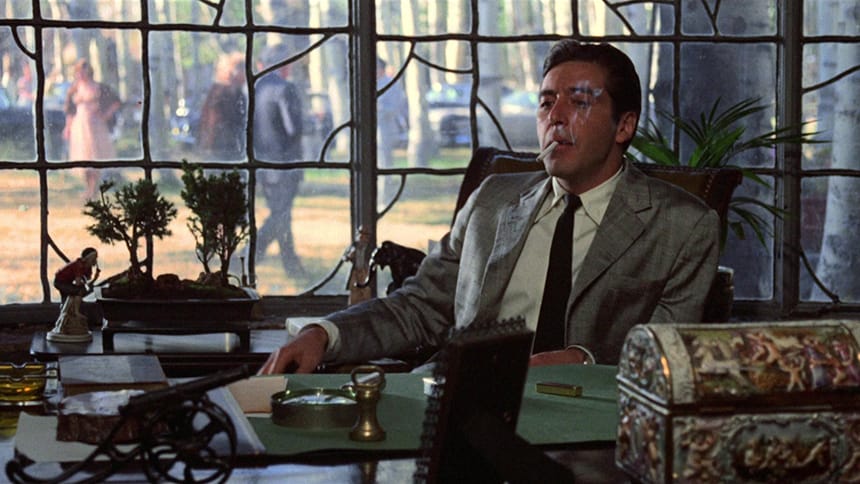
The Godfather Part II (1974)
Dir. Francis Ford Coppola · DP: Gordon Willis · Cast: Al Pacino, Robert De Niro, Robert Duvall, Diane Keaton, Talia Shire, Michael V. Gazzo, Lee Strasberg, G.D. Spradlin
One of the very few sequels that doesn't just justify its own existence — it retroactively deepens the original, turning what was already a landmark into the first half of something even larger and darker. Francis Ford Coppola pulls off the impossible: a film that operates simultaneously as prequel and sequel, tragedy and indictment, elegy and warning. The twin narratives move in opposite directions by design. Gordon Willis — working again with the chiaroscuro language he pioneered on THE GODFATHER, here pushed further into shadow — contrasts the sunlit warmth of early 20th-century Sicily and New York with the cold, funeral blues of 1950s Lake Tahoe, where Michael Corleone's empire has hardened into something glacial. The visual grammar says everything the characters cannot: Vito Corleone built something out of survival and love, however warped; Michael has built a prison and calls it a kingdom.
Robert De Niro, in the performance that won him the Academy Award for Best Supporting Actor, plays the young Vito with a watchful, contained intensity — a man spending nothing he doesn't have to, building toward power with the patience of someone who understands that patience is the only weapon the powerless actually own. Al Pacino's Michael, meanwhile, completes his transformation. By the film's annihilating final sequence — Michael alone at the lake, the family gone, the empire intact — Coppola has made the most devastating case for what absolute power actually costs.
Winner of six Academy Awards, including Best Picture, Best Director, and Best Supporting Actor — the only sequel in history to win Best Picture. Five decades later, it remains the standard against which all sequels measure themselves, and almost none survive the comparison.
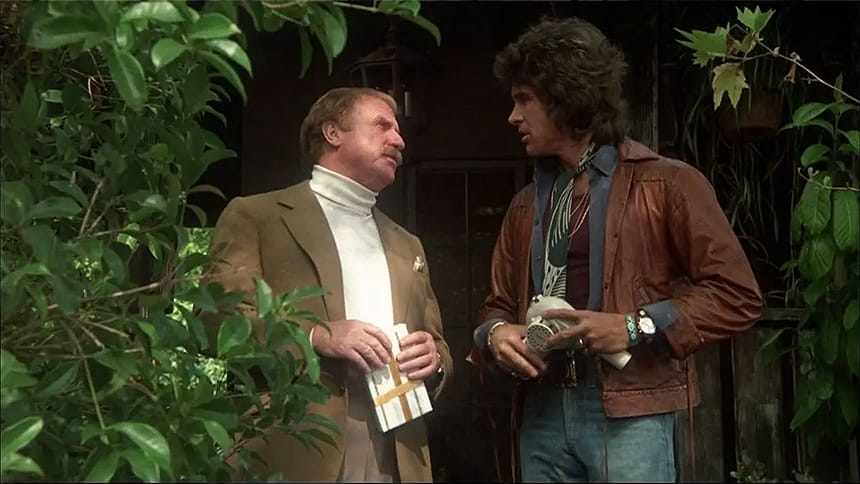
Shampoo (1975)
Dir. Hal Ashby · DP: László Kovács · Cast: Warren Beatty, Julie Christie, Goldie Hawn, Lee Grant, Jack Warden, Carrie Fisher
Set on the eve of Richard Nixon's 1968 election, SHAMPOO is Hal Ashby and Warren Beatty's most sharply political film — a satire of the "Me Decade" disguised as a bedroom farce. Beatty plays George Roundy, a Beverly Hills hairdresser conducting simultaneous affairs with a constellation of women (Julie Christie, Goldie Hawn, Lee Grant, Carrie Fisher) while the television in the background confirms that the world is about to change in ways that will make his particular brand of narcissism very expensive.
László Kovács's soft-focus cinematography gives the film a hazy, golden warmth — the light of a California about to learn a hard lesson about itself. Lee Grant won the Academy Award for Best Supporting Actress; Carrie Fisher, in her film debut, contributes a memorable scene that announces the arrival of someone the world isn't quite ready for yet. Witty, stylish, and deeply disillusioned, SHAMPOO understands that the counterculture didn't die — it got assimilated.
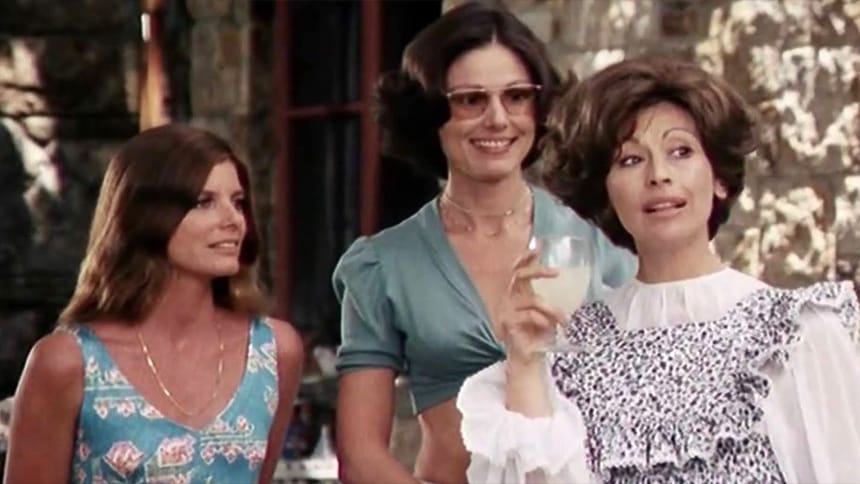
The Stepford Wives (1975)
Dir. Bryan Forbes · DP: Owen Roizman · Cast: Katharine Ross, Paula Prentiss, Peter Masterson, Patrick O'Neal, Nanette Newman, Tina Louise
Bryan Forbes's THE STEPFORD WIVES is not the most technically assured film in this volume — Forbes was a craftsman rather than a visionary, and the pacing occasionally betrays a director working at the edge of his range — but what burns through the sometimes uneven filmmaking is an idea so potent it has only grown more so with time. Ira Levin's satirical novel about a Connecticut suburb where men have quietly replaced their wives with compliant android replicas becomes, in Forbes's hands, a slow-burn horror of male fear and female erasure: a film about the violence of normalization.
Katharine Ross and Paula Prentiss are excellent as the women who understand what's happening too late, and Tina Louise — Ginger from GILLIGAN'S ISLAND — contributes a quietly unsettling supporting turn. Like Levin's other great novel, ROSEMARY'S BABY, THE STEPFORD WIVES has proven impossible to shake — a film that keeps becoming more relevant as society keeps providing new reasons to revisit it. In 2026, it lands like a warning that arrived fifty years too early and is still being ignored.
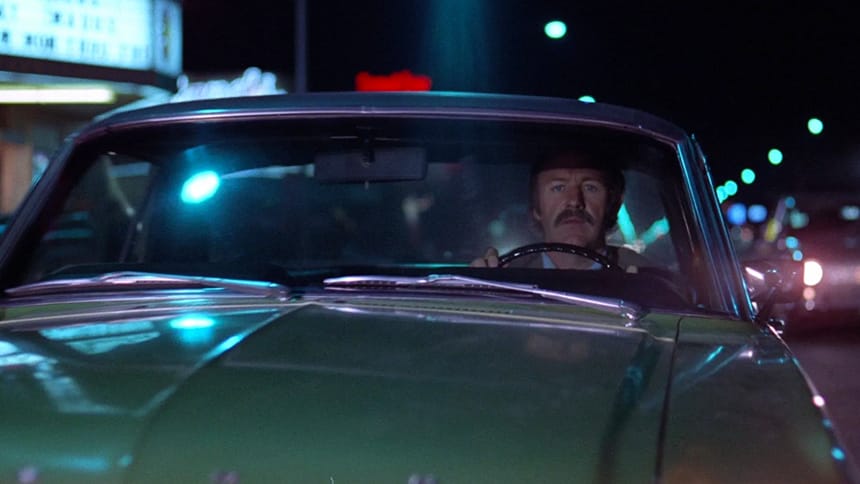
Night Moves (1975)
Dir. Arthur Penn · DP: Bruce Surtees · Cast: Gene Hackman, Jennifer Warren, Edward Binns, Harris Yulin, Janet Ward, James Woods, Melanie Griffith
The post-Watergate neo-noir to end all post-Watergate neo-noirs. Arthur Penn's NIGHT MOVES is a film in which the detective doesn't just lose the plot — he loses his bearings entirely in a world that has outpaced his moral compass, and ours. Gene Hackman is at his most weathered as Harry Moseby, a man trying to solve someone else's mystery while his own life quietly falls apart around him. The case — a runaway girl, a bleached-out Florida that functions as the film's trap rather than its playground — seems solvable until it isn't, and then it's something much worse.
Bruce Surtees's cinematography gives Florida a flat, naturalistic light that offers nowhere for the truth to hide, and Penn directs with the calm of a man who already knows the ending isn't good. James Woods and a young Melanie Griffith appear in early roles that hint at what both would become. One of the most downbeat films in this entire series — and the one that understands, with the greatest precision, that the puzzle isn't missing pieces. The picture on the box was always a lie.
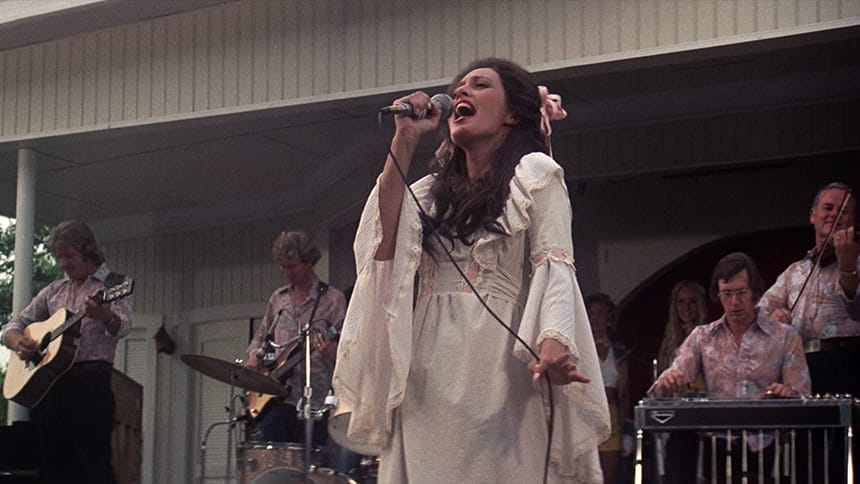
Nashville (1975)
Dir. Robert Altman · DP: Paul Lohmann · Cast: Ned Beatty, Karen Black, Ronee Blakley, Keith Carradine, Geraldine Chaplin, Shelley Duvall, Henry Gibson, Barbara Harris, Michael Murphy, Lily Tomlin, Gwen Welles, Keenan Wynn
The most ambitious American film of 1975, Robert Altman's NASHVILLE deploys twenty-four speaking characters across five days in the country music capital, weaving them together with the 24-track recording technology pioneered by sound engineer Jim Webb — a filmmaking system as sprawling, democratic, and chaotic as the America it was trying to describe.
Paul Lohmann's restless, observational lens moves through the crowd without hierarchy, giving a bit player the same attention as a star, and Altman's "hub-and-spoke" structure — disparate lives drawn together by shared location and a mysterious political rally — inspired Richard Linklater, Paul Thomas Anderson, and Spike Lee, among others
NASHVILLE captured the fractured, self-important, desperately optimistic soul of a country approaching its Bicentennial — too loud and too distracted to hear what was already giving way beneath the stage. Fifty years later, as the country fires up the bunting for its 250th birthday, NASHVILLE would like a word.
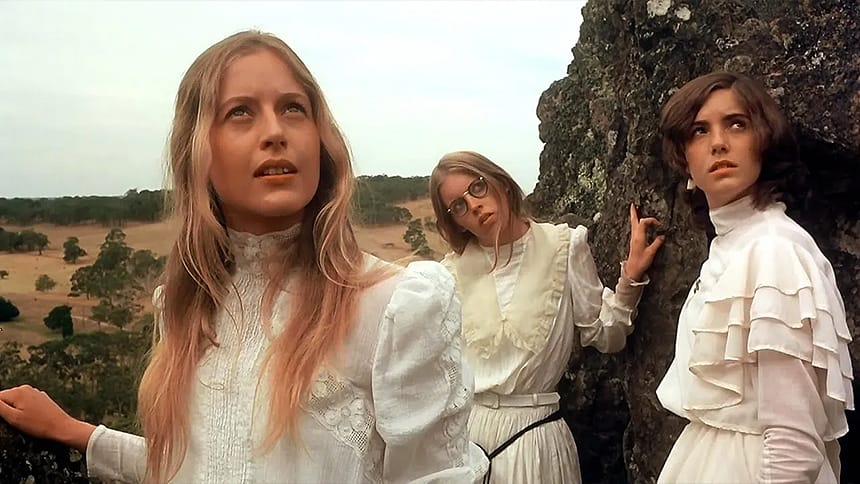
Picnic at Hanging Rock (1975)
Dir. Peter Weir · DP: Russell Boyd · Cast: Rachel Roberts, Anne-Louise Lambert, Helen Morse, Vivean Gray, Jacki Weaver, Dominic Guard
PICNIC AT HANGING ROCK arrives from outside the American New Hollywood orbit — Peter Weir was working in Australia, where a parallel cinematic revolution was well underway — but its kinship with the films in this series is unmistakable: here is another story about the violence that rigid institutional structures do to the people inside them, rendered in the language of dream rather than documentary.
Russell Boyd's shimmering, soft-focus photography — achieved by famously shooting through bridal veil filters — creates a luminous, waking hallucination. The blinding white corsets and rigid Victorian propriety of the schoolgirls slowly dissolve into the ancient, primordial, and completely indifferent heat of the Australian bush. The film offers no explanation for what happens to the girls who disappear on Valentine's Day, 1900, which is precisely the point: the unknowable exerts its own power, and civilization's systems of logic and control have no purchase on it. Weir described his approach as a "hallucinatory mesmeric rhythm," and he achieved it with an exactness that borders on the uncanny.
HANGING ROCK provided a foundational blueprint for the feminine gothic — echoed in Sofia Coppola's THE VIRGIN SUICIDES — the "spirit of place" unease of David Lynch's TWIN PEAKS, and the oppressive daylight horror of Ari Aster's MIDSOMMAR. Elegant, deeply disturbing, and one of cinema's most beautiful nightmares.
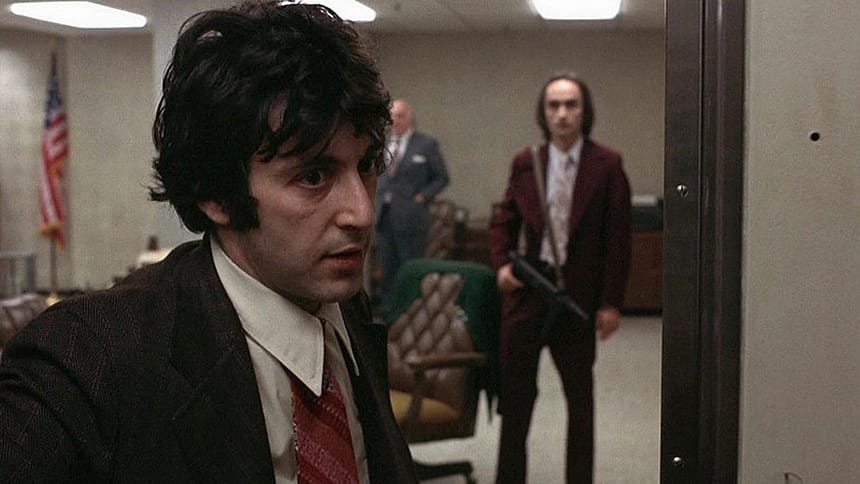
Dog Day Afternoon (1975)
Dir. Sidney Lumet · DP: Victor J. Kemper · Cast: Al Pacino, John Cazale, Charles Durning, James Broderick, Carol Kane, Chris Sarandon
Sidney Lumet closes out this volume at full volume. Al Pacino is a lightning strike of pure, frantic energy as Sonny Wortzik, a man who accidentally becomes a folk hero while drowning in a situation that spiraled out of control hours ago. Victor J. Kemper's gritty, street-level cinematography and Dede Allen's kinetic editing give the film a documentary urgency that makes the Brooklyn heat feel oppressive — a city pressed up against a bank window, chanting for a man it doesn't know because it recognizes the desperation underneath.
John Cazale registers every note of Sal's unwavering loyalty — a performance of crushing understatement in a film that is otherwise turned up to eleven. Chris Sarandon, in his film debut, received an Oscar nomination for his performance as Sonny's wife, a role that required enormous courage in 1975 and remains, over fifty years later, one of the most humane portrayals of a trans woman in Hollywood history. Combustible, tragic, and surprisingly funny — in Lumet's hands, a botched robbery becomes a love letter to everyone the system has already given up on.
That's Volume III. Fifteen films shaped by artists — some who never lived to see how far the rot would spread, others who did and kept making work anyway — who understood that the only honest response to institutional collapse is to hold it up to the light for all to see. They gave it a name. They put it on screen. That still matters.
Volume IV is coming — opening with Miloš Forman's ONE FLEW OVER THE CUCKOO'S NEST and closing with Francis Ford Coppola's APOCALYPSE NOW. We're moving into 1975–1979, the years after Vietnam, when the national mood curdled from outrage into exhaustion — and American cinema somehow got angrier. The machine doesn't just crush the individual anymore. It sends its best men into the jungle to kill the monsters it created — and discovers, at the end of the river, that the horror was always homegrown.
Stay tuned. 📺
🍕 POP 'N' PIZZA is your deep-dish slice of pop culture's weirdest, most esoteric corners—served with extra sauce and a side of existential dread. Written by Adam Frazier.