While the World Burns: Volume VI
A film series covering 80 films from 1959 to 1989, from the waning days of the studio system through the early tremors of New Hollywood to the excess of the '80s.

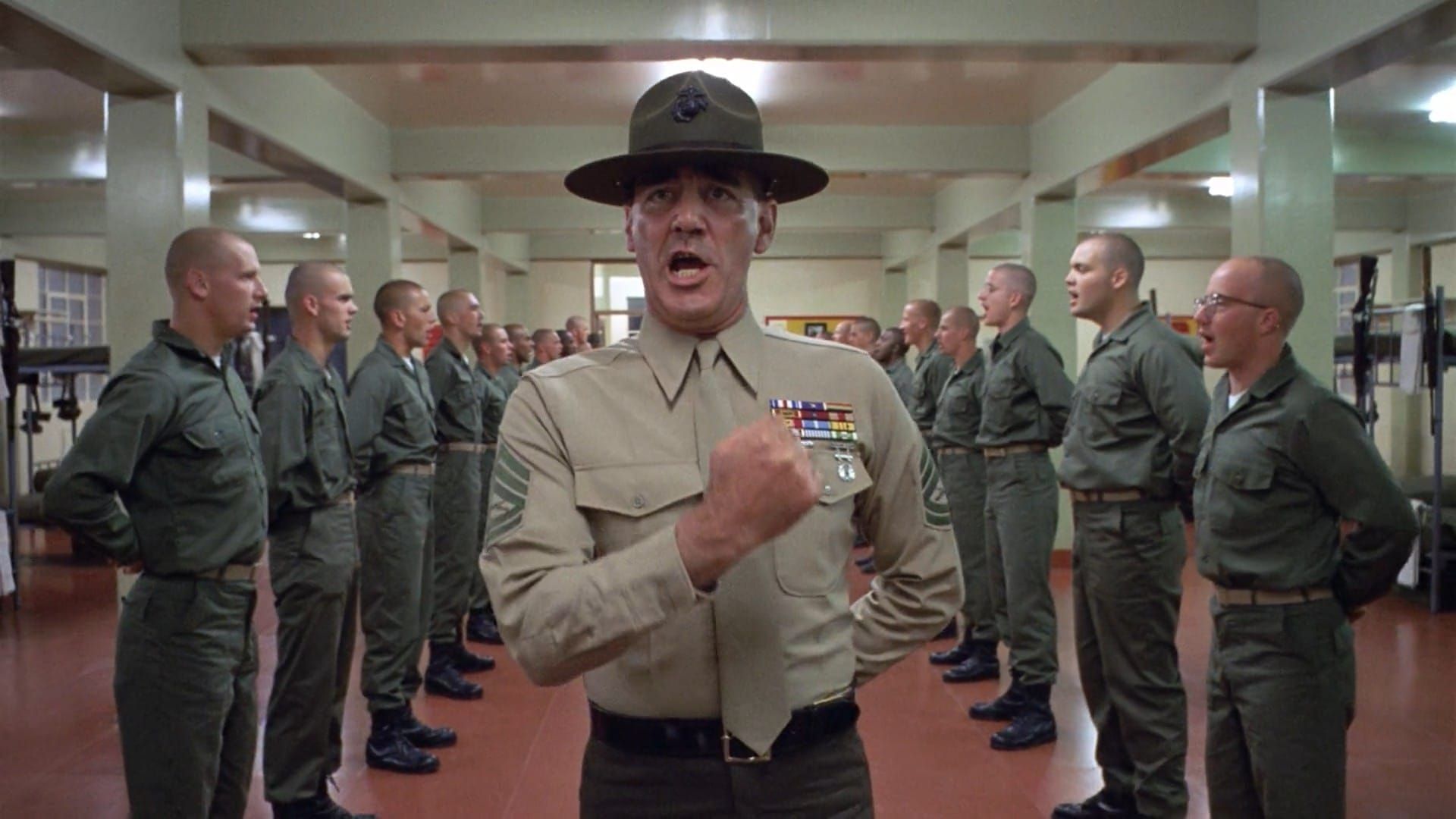
80 films and 30 years of cinema later, we've reached the end of WHILE THE WORLD BURNS. Volume VI covers 1984 to 1989 — ten films made by filmmakers who lived through the '60s and '70s and saw every ideal of that era quietly abandoned, co-opted, or sold back to them. The counterculture became a marketing demographic. The revolution became a lifestyle brand. The dream of dropping out was replaced by cashing in, and the radical quest to find yourself mutated into an obsessive pursuit of net worth.
The cinema of this period is both mirror and indictment of that spiritual surrender — capturing a culture in real time through the existential panic of yuppies, the corporate decay of the evening news, the brutal mechanics of labor suppression, and the military-industrial complex that turns men into killing machines. In this final volume, the filmmakers who stood amidst the neon glow of Reagan's America chart the end of the line: documenting a generation that stopped trying to change the world and decided instead to watch it burn in comfort and luxury.
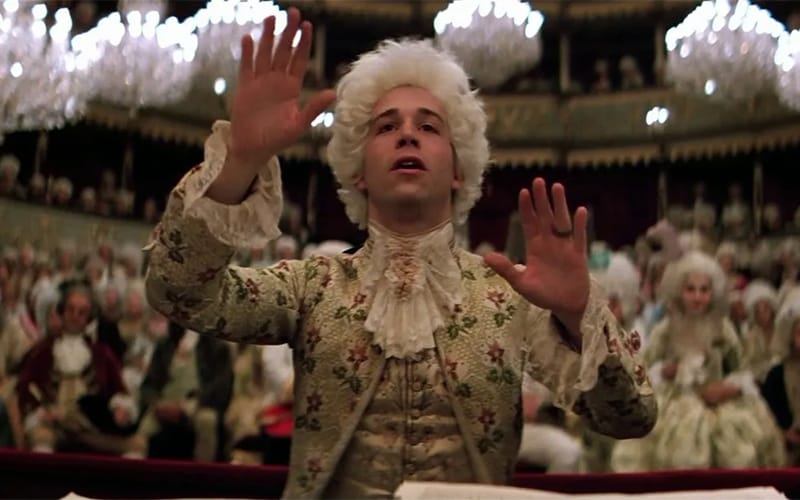
Amadeus (1984)
Dir. Miloš Forman · DP: Miroslav Ondříček · Cast: F. Murray Abraham, Tom Hulce, Elizabeth Berridge, Simon Callow, Jeffrey Jones
Miloš Forman returns to this series for the first time since 1975's ONE FLEW OVER THE CUCKOO'S NEST — and the through-line is unmistakable. Both films are about institutions (an Oregon psychiatric hospital and the Viennese royal court) that cannot tolerate what they cannot categorize — and move swiftly to eliminate it.
Antonio Salieri (F. Murray Abraham), a court composer of genuine skill and catastrophic self-awareness, watches Wolfgang Amadeus Mozart (Tom Hulce) tear through his world with the vulgar, giggling ease of someone touched by something Salieri can recognize but never reach. The divine, Forman argues, does not distribute talent according to moral virtue or hard work. Salieri is the more disciplined composer, the more socially acceptable man, the one who played by every institutional rule. None of it matters. His war is ultimately with God — and he wages it by using his political proximity to the Emperor to systematically defund, isolate, and exhaust the one man whose existence proves the universe is indifferent to merit.
Miroslav Ondříček — who shot SILKWOOD the previous year — wraps the Viennese court in warm, gorgeous candlelight that makes the cruelty feel civilized. The film closes with Salieri in an asylum, wheeling among the other patients, offering what he can: "Mediocrities of the world — I absolve you." He has become the patron saint of everyone who ever looked at genius and felt the quiet, burning ache of their own limitations. Myself included.
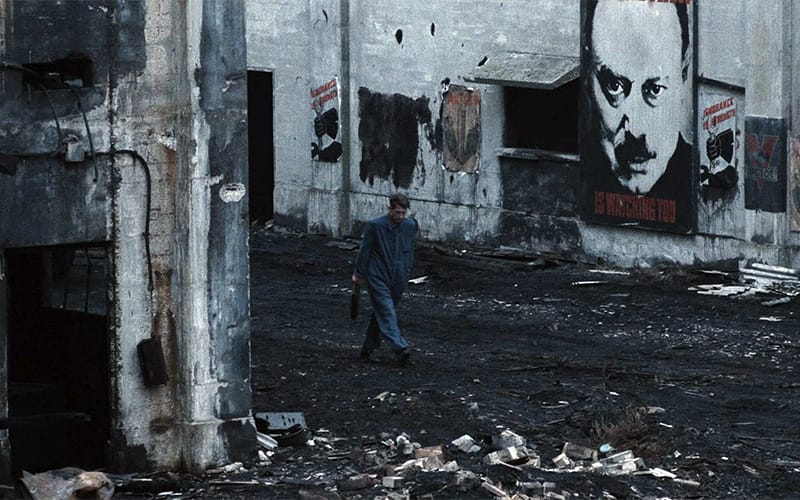
Nineteen Eighty-Four (1984)
Dir. Michael Radford · DP: Roger Deakins · Cast: John Hurt, Richard Burton, Suzanna Hamilton, Cyril Cusack
George Orwell's NINETEEN EIGHTY-FOUR is one of the few novels that has genuinely altered the language — Big Brother, doublethink, memory hole, thoughtcrime — words that entered the culture so completely we use them without remembering where they came from. Adapting it is less a creative challenge than a test of nerve: the material is so influential, so loaded, that any cinematic version risks becoming either a slideshow or a sermon. Michael Radford's 1984 film is neither.
Winston Smith (John Hurt) is a minor functionary of Oceania's Ministry of Truth who rewrites historical records for a living — erasing inconvenient facts, replacing them with whatever the Party requires. His small private rebellion begins with a diary and accelerates into a forbidden love affair with Julia (Suzanna Hamilton). The Inner Party, personified by Richard Burton in his final screen performance, doesn't merely punish dissent — it dismantles the psychological capacity for love until the state becomes the only remaining reality. Burton died before the film was released. The weight of that is in every frame he's in.
Roger Deakins — here for his only series appearance, early in a career that would produce some of the most luminous cinematography of the next four decades — used a rare bleach-bypass process to strip Oceania of vibrant color, rendering it in desaturated grays and browns as if warmth itself had been rationed by the state.
John Hurt would return to this territory twenty years later, playing the totalitarian High Chancellor in V FOR VENDETTA — the inversion almost too neat: the crushed individual becomes the crushing institution, two sides of the same nightmare. In 2026, with governments and corporations monitoring behavior through digital screens, reshaping historical records in real time, and declaring inconvenient truths as misinformation, NINETEEN EIGHTY-FOUR reads less like dystopian fiction and more like the evening news.
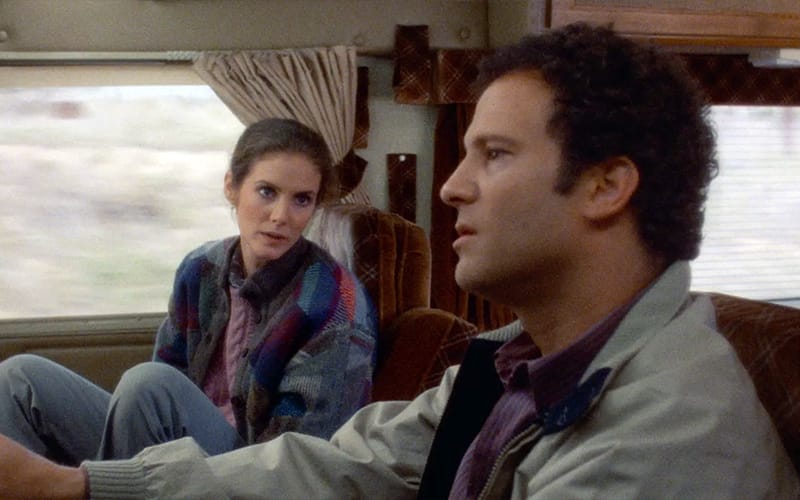
Lost in America (1985)
Dir. Albert Brooks · DP: Eric Saarinen · Cast: Albert Brooks, Julie Hagerty, Michael Schildkraut, Art Frankel
Dennis Hopper's EASY RIDER came out in 1969, and a generation of Americans decided it was about them — the open road, the counterculture, the beautiful refusal to be owned by the machine. By 1985, those same Americans had corporate titles, Mercedes-Benzes, and mortgages. Albert Brooks made LOST IN AMERICA about what happened when one of them tried to escape the system.
David (Brooks) is a Los Angeles advertising executive who, after being passed over for a promotion, does the unthinkable: he convinces his wife Linda (Julie Hagerty) to quit their jobs, sell their house, and buy a Winnebago to "drop out of society." They make it as far as Las Vegas before Linda, left alone at the casino for one night, gambles away their entire life savings at the roulette wheel. The dream dies there, at a roulette table in Nevada, and what follows is the film's darkest and funniest argument: without their nest egg, David and Linda discover they are completely helpless.
They take minimum-wage jobs in a small Arizona town — David as a crossing guard at an elementary school, Linda as the assistant manager at the local Der Wienerschnitzel — and the open road that was supposed to set them free reveals itself as just another cage, this one without the benefits package. Hagerty's Linda is the film's secret weapon — fragile, funny, and completely convincing as a woman who gambled away everything because, somewhere beneath the fantasy, she already knew they were going back.
LOST IN AMERICA is perhaps the sharpest self-portrait of the '80s: a generation that mythologized rebellion and discovered, the moment rebellion was required, that they'd been institutionalized far too deeply to survive without the institution. They wanted the open road and a safety net — but you can't have both. The safety net is the system they tried to escape.
Smooth Talk (1985)
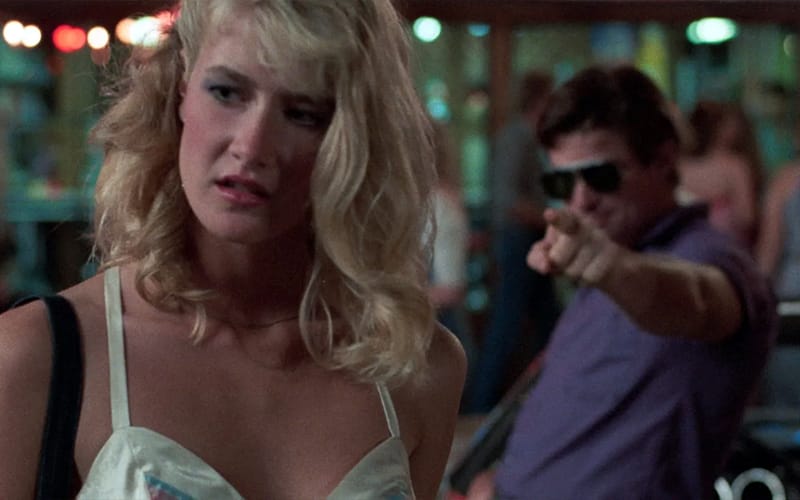
Dir. Joyce Chopra · DP: James Glennon · Cast: Laura Dern, Treat Williams, Mary Kay Place, Levon Helm
Joyce Carol Oates's short story "Where Are You Going, Where Have You Been?" is one of American literature's most studied and most unsettling pieces of short fiction. Joyce Chopra's 1985 adaptation, winner of the Grand Jury Prize at Sundance, understands that true horror lives in the ordinary — and builds its first hour accordingly.
15-year-old Connie (Laura Dern) is restless, boy-crazy, and entirely normal — a girl whose greatest crime is wanting to be older than she is. Chopra and DP James Glennon shoot the first half in warm, hazy summer light, the kind that makes a shopping mall parking lot feel like a world full of possibility. It is a completely convincing coming-of-age portrait, and that's the trap: by the time Arnold Friend (Treat Williams) pulls into the driveway, the film has endeared you to Connie so completely that what follows is almost unbearable.
Williams is one of the great understated villain performances of this series — soft-voiced, almost courtly, his menace arriving not through aggression but through a terrible, patient certainty that he has already won. He doesn't need to force anything. He simply waits, the way skilled predators do, until the distance between what his prey wants and what she's afraid of collapses.
SMOOTH TALK is about the gap between the fairytale teenage girls are told about growing up — that attention is power, that youth and beauty give them agency over men — and how unprepared they are when confronted with real-world malice. Arnold Friend understands this better than Connie does. He uses the language of pop music and teenage culture to mask his predatory motives — a wolf in sheep's clothing who prowls the daydreams of adolescence, where seduction and coercion are indivisible, luring Connie to a tragic point of no return.
After Hours (1985)
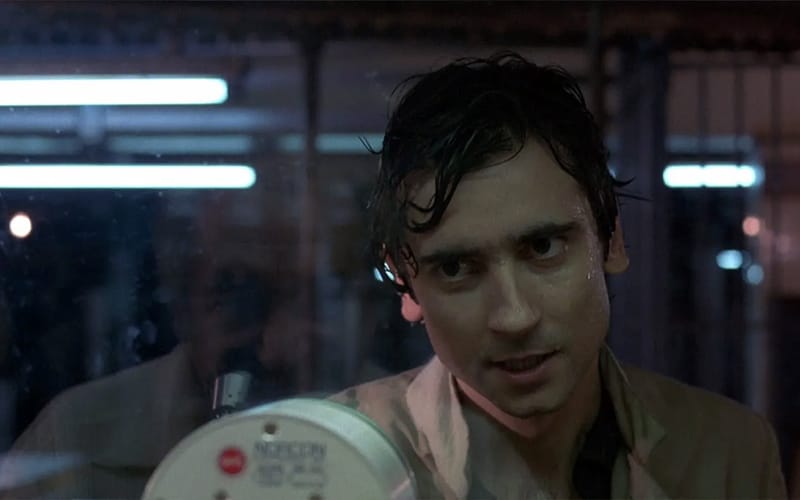
Dir. Martin Scorsese · DP: Michael Ballhaus · Cast: Griffin Dunne, Rosanna Arquette, Linda Fiorentino, Teri Garr, John Heard, Catherine O'Hara
Martin Scorsese’s third entry in the series—following TAXI DRIVER's descent into the urban moral sewer and THE LAST WALTZ's elegiac farewell to the counterculture—finds him operating in an entirely different register: New York as a Kafkaesque labyrinth, a paranoid machine designed to break outliers and return them to their cubicles by sunrise.
Griffin Dunne gives a career-best performance as Paul Hackett, a mild-mannered Uptown word processor whose modest quest for a late-night SoHo hookup with Marcy (Rosanna Arquette) spirals into a surreal nightmare of escalating anxieties and absurdities. Along the way, he collides with a rogue's gallery of Downtown eccentrics: sculpted-plaster artists (Linda Fiorentino), neurotic, beehived waitresses (Teri Garr), and ice cream truck-driving vigilantes (Catherine O’Hara).
Working alongside cinematographer Michael Ballhaus and editor Thelma Schoonmaker, Scorsese uses kinetic whip-pans and muscular cutting to transform routine urban inconveniences into relentless cosmic persecution. AFTER HOURS is a masterfully orchestrated, dizzyingly frantic dark comedy built for anyone who has ever suspected the universe is actively plotting against them.
Matewan (1987)
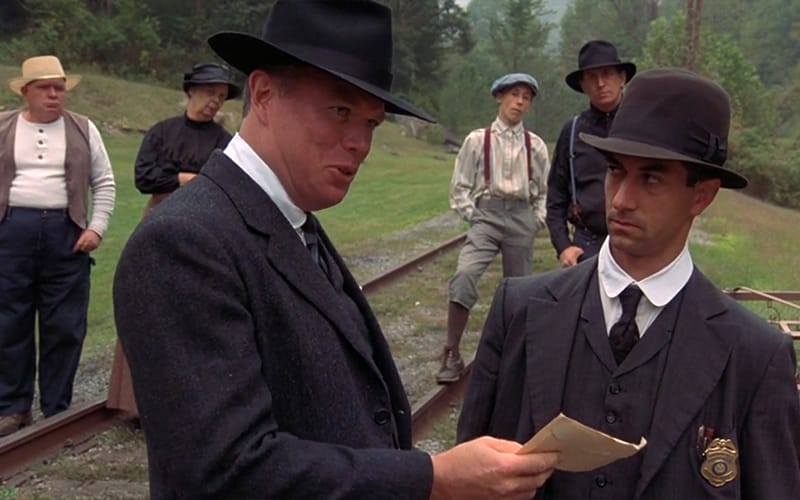
Dir. John Sayles · DP: Haskell Wexler · Cast: Chris Cooper, James Earl Jones, Mary McDonnell, David Strathairn, Kevin Tighe, Bob Gunton
Written and directed by John Sayles — who financed his independent films by writing genre movies he didn't care about (PIRANHA, THE HOWLING, ALLIGATOR) so he could make the ones he did — MATEWAN joins HARLAN COUNTY USA, BLUE COLLAR, and SILKWOOD as the series' labor spine. Based on the real 1920 Matewan Massacre, the film serves as a powerful reminder that the machinery of corporate exploitation isn't a modern invention — and that when economic power becomes unchecked civic power, it creates an infrastructure that offers just enough stability to make dissent feel more dangerous than compliance. Corruption isn't an aberration — it's the system working as intended.
Haskell Wexler arrives for his third series appearance — after WHO'S AFRAID OF VIRGINIA WOOLF? and ONE FLEW OVER THE CUCKOO'S NEST — three politically charged films across three decades, each shot with the conviction of a man who wields the camera as an extension of his conscience. His desaturated, earth-toned palette drops you into 1920 Mingo County, West Virginia, where the Stone Mountain Coal Company doesn't just own the mines — it owns the houses, stores, schools and churches, the law, and the gun-toting thugs hired to starve, evict, and terrorize anyone who organizes.
Labor organizer Joe Kenehan (Chris Cooper, in his film debut) arrives to unite a fractured workforce of local miners, displaced Black workers led by Few Clothes Johnson (James Earl Jones, whose gravitas anchors every scene he's in), and newly arrived Italian immigrants. The company's response isn't confrontation — it's fragmentation, weaponizing racial prejudice and xenophobia to keep workers too busy hating each other to look up at who owns everything. In 2026, with corporations still running the same divide-and-conquer playbook across lines of race, citizenship, and seniority, MATEWAN isn't ancient history. It's a call to arms for the here and now.
Full Metal Jacket (1987)
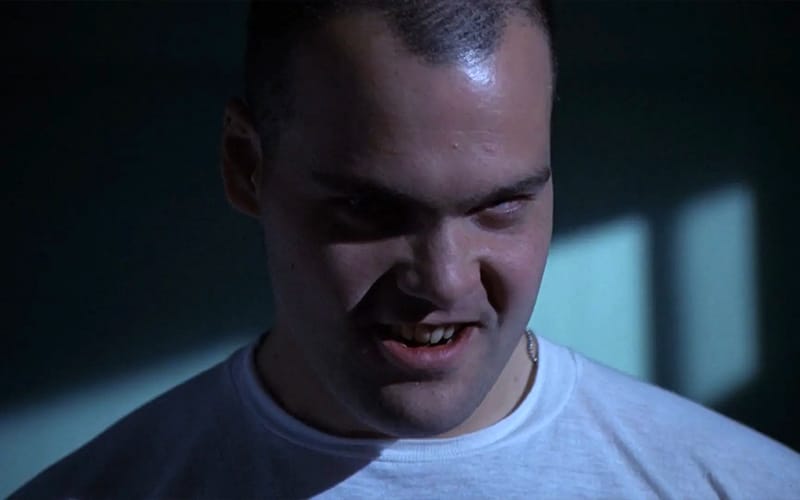
Dir. Stanley Kubrick · DP: Douglas Milsome · Cast: Matthew Modine, Vincent D'Onofrio, R. Lee Ermey, Arliss Howard, Adam Baldwin
DR. STRANGELOVE skewered the bureaucratic absurdity of the military-industrial complex. M*A*S*H used dark humor to expose the harsh realities of combat, while APOCALYPSE NOW followed the rules of war to their absolute, horrific end. Stanley Kubrick — making his fifth and final series appearance — returns to the subject he helped define and goes somewhere none of those films went: the factory floor. The assembly line. The place where men are unmade and rebuilt as weapons.
Kubrick splits JACKET into two deliberately mismatched halves. The first — Parris Island boot camp — is cold, geometrically precise, and comic in its crude efficiency. R. Lee Ermey — a real Marine Corps drill instructor who ad-libbed much of his dialogue — gives one of cinema's great performances as Gunnery Sergeant Hartman: a man so completely defined by the institution he serves that he has no existence outside it. Opposing him, Vincent D'Onofrio's Private Pyle — gentle, lost, fundamentally unsuited for what the machine requires — undergoes a transformation so complete and so terrible it becomes the film's darkest irony: the factory produces a killing machine, but it's a defect, turning on its maker and then itself. The line keeps moving.
The second half follows Private Joker (Matthew Modine) into the rubble of Huế during the Tet Offensive, and Douglas Milsome's camera shifts with it — the geometric precision of boot camp replaced by smoke, fire, and chaos. Joker wears a peace button on his jacket and "Born to Kill" on his helmet. When a colonel demands he explain the contradiction, Joker says it's a comment on the duality of man. He's half-joking. The film isn't. FULL METAL JACKET's argument isn't that war makes men evil — it's that the institution makes the distinction between good and evil irrelevant. The film ends with the unit marching through the ruins of civilization as graduates of war, singing the Mickey Mouse Club theme. Joker's peace button is still there. Whatever it was attached to isn't.
Broadcast News (1987)
Dir. James L. Brooks · DP: Michael Ballhaus · Cast: Holly Hunter, Albert Brooks, William Hurt, Robert Prosky, Lois Chiles, Joan Cusack
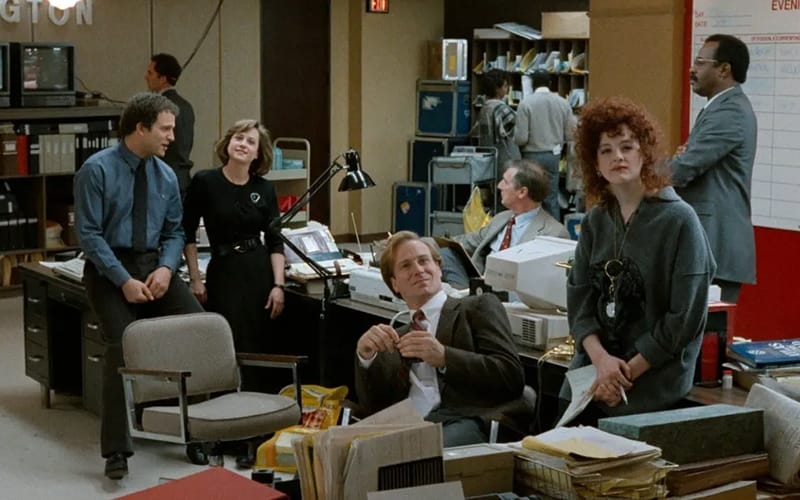
NETWORK predicted it in 1976: the news would eventually be consumed by the entertainment machine, truth replaced by performance, outrage packaged and sold as programming. A decade later, James L. Brooks spent a year embedded inside CBS and NBC news bureaus and discovered the transformation was already underway. BROADCAST NEWS is not a satire of television journalism. It is a documentary of its surrender.
The film tracks three people caught in the same undertow. Jane (Holly Hunter, nominated for Best Actress) is a producer of ferocious ethical integrity who understands exactly what's being lost and is powerless to stop it. Aaron (Albert Brooks) is a brilliant reporter with everything except the camera presence the new order requires. And Tom (William Hurt) is the future: handsome, warm, intellectually lightweight, and completely comfortable with what he is.
The film's moral pivot arrives when Tom is caught staging a cutaway shot of himself crying during an interview — manufacturing emotion for the camera after the fact. Jane confronts him. He doesn't deny it. He doesn't understand why it matters. That incomprehension is the film's real horror: not that the line was crossed, but that the concept of a line has become genuinely foreign. BROADCAST NEWS is a brilliant, melancholic eulogy for journalism, showing the erosion of our collective reality began the moment we demanded the news make us feel good.
The Last Temptation of Christ (1988)
Dir. Martin Scorsese · DP: Michael Ballhaus · Cast: Willem Dafoe, Harvey Keitel, Barbara Hershey, Harry Dean Stanton, David Bowie
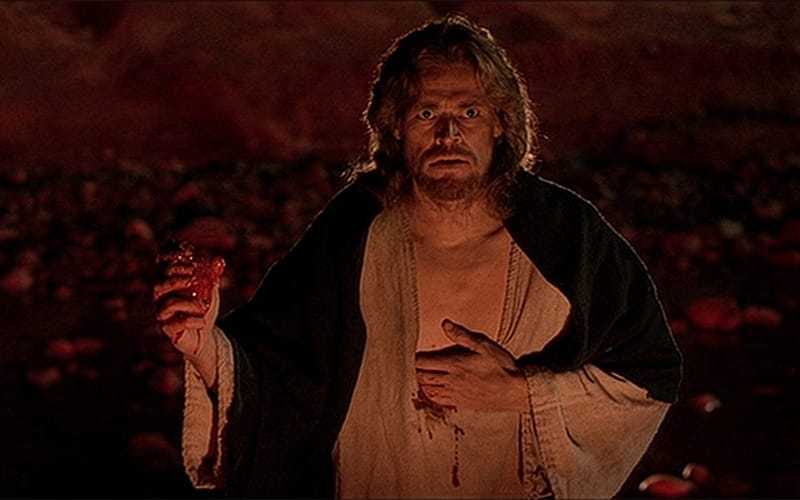
Martin Scorsese's THE LAST TEMPTATION OF CHRIST arrived in August 1988 in the midst of a firestorm — fundamentalist protests, a bombing at a Paris cinema, bans in several countries, and death threats. The controversy was the film's argument made visible: an institution so threatened by a human portrayal of its central figure that it mobilized to suppress it. Adapted by Paul Schrader (TAXI DRIVER, BLUE COLLAR) from Nikos Kazantzakis's 1955 novel, the film depicts Jesus Christ as a man torn between his divine mission and human desires.
Willem Dafoe's Jesus is not the serene, heroic figure of Hollywood biblical epics. The miracles happen, but the flesh is equally real — the doubt, the fear, the lust, the desperate longing for an ordinary life. To be both human and divine is not a superpower. It is a contradiction that has to be lived, moment by moment, in a body that can feel every thorn and nail. Harvey Keitel's Judas is the film's most radical reinterpretation — not a betrayer but a loyal servant, doing what Jesus asks of him, carrying the weight of history's most misunderstood act of love.
The titular temptation arrives on the cross, where Satan — appearing as a young girl — offers Jesus a way out: step down, live a normal life, marry Mary Magdalene, grow old, and die surrounded by people who love you. Scorsese lingers in this sequence, making ordinary life feel beautiful. You feel the pull of it. The film closes with Jesus crying out that it is accomplished, not in victory but in exhausted relief, the terrible weight finally set down.
In a series defined by individuals crushed by institutions, THE LAST TEMPTATION OF CHRIST offers the most extreme version of that burden: a man cursed by expectation, who must live up to the impossible standards others have set for him.
Born on the Fourth of July (1989)
Dir. Oliver Stone · DP: Robert Richardson · Cast: Tom Cruise, Kyra Sedgwick, Raymond J. Barry, Jerry Levine, Willem Dafoe
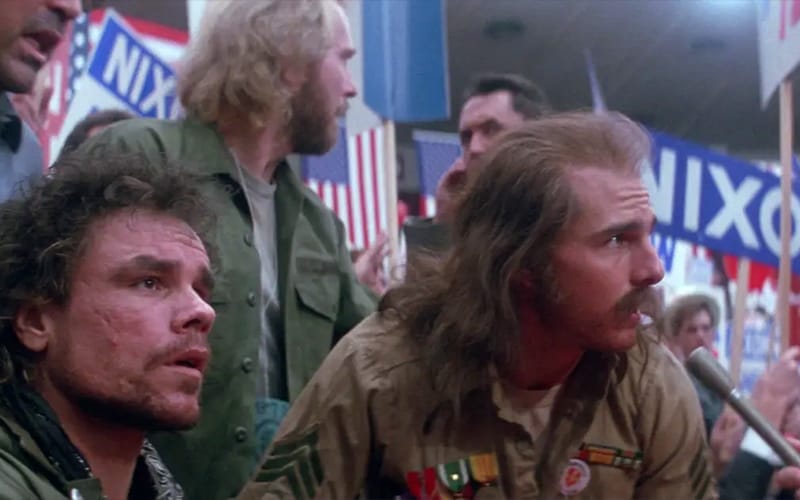
Directed by Oliver Stone, 1989's BORN ON THE FOURTH OF JULY explores what happens to the man who survives war, comes home, and discovers that the country he nearly died for has already moved on. The answer belongs to Ron Kovic (Tom Cruise) — paralyzed Vietnam veteran, anti-war activist, and co-author of the screenplay alongside Stone. That last detail matters: this is not a filmmaker interpreting someone else's trauma. It is a man writing his own story, which gives every scene authority and authenticity.
Robert Richardson's cinematography traces Kovic's arc in the film's visual language — the warm, saturated Norman Rockwell Americana of his Long Island childhood, the flag-waving patriotism of a boy who believed every word, gives way to the desaturated, sickly light of hospitals, the chaos of combat, and anger of the anti-war movement. The America that sent him to war is shot like a dream. What he comes back to is a rude awakening - abrupt, harsh and revelatory in its truth.
Tom Cruise's performance is one of the great against-type transformations — not a star playing a role but an actor dismantling his own image, scene by scene, until nothing of the golden boy remains. Ron Kovic returns home in a wheelchair to a country that cheers its soldiers into war and turns away from their shattered lives upon return, the hypocrisy laid bare in a nightmarish VA hospital sequence that is, perhaps, one of the most damning indictments of American institutional failure committed to film.
Kovic's journey from true believer to anti-war activist is what happens when a man assembled by the machine decides to destroy it - an honest reckoning with what American mythology costs the people who believe in it most completely.
If you've made it this far, thank you. Genuinely. This series started as a personal project—a way of processing our present through the lens of our cinematic past—and grew into something far larger thanks to the readers who showed up, subscribed, and watched along.
Of all the first-time watches in this final volume, the film that stayed with me most was MATEWAN. It isn’t the flashiest or most acclaimed entry here, but it carries the quiet, undeniable authority of an eternal truth: the company owns the mine, the house, the law, and the worker. And yet, knowing the machinery is built to crush us, we rage against it anyway.
Across 80 films and 30 years of cinema, that stubborn refusal is what WHILE THE WORLD BURNS was always about. The systems designed to break us will keep running, but these movies preserve the human cost of resistance — reminding us that someone, somewhere, stood up to document the truth. The world keeps burning, and we keep watching, hoping that one day we'll finally learn how to put out the fire instead of feeding the flames.
Stay tuned. 📺
🍕 POP 'N' PIZZA is your deep-dish slice of pop culture's weirdest, most esoteric corners—served with extra sauce and a side of existential dread. Written by Adam Frazier.